 Windowbox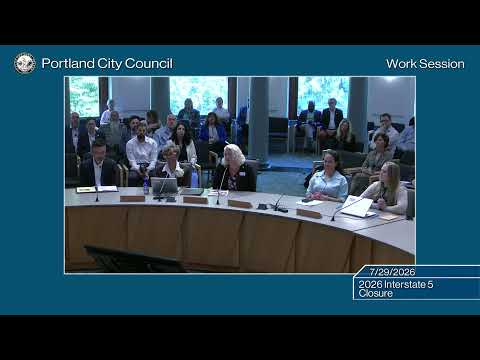
Transcript
Automatically generated transcript. It may contain errors and includes testimony in languages other than English that is not individually marked up for assistive technology.
Jamie Dunphy 5:30 - 6:32
Good afternoon, friends.
I am calling to order this work session of the Portland City Council.
Do we take roll on this?
Nah, no roll for work sessions.
We're just here.
Thanks everybody for being here today.
We are here to discuss ODOT's upcoming closure of southbound I-5 through the Rose Quarter beginning on September 11th and lasting for up to 5 weeks.
We have friends from ODOT here today along with representatives from many of our city bureaus to walk us through an overview of the project, the current operational and engagement efforts, And the mitigation strategies underway.
This closure is going to impact our entire city.
I also want to flag that this appears to be the first of several closures of this type that ODOT is planning going forward.
So what we learn today matters beyond just September.
Councilors, this is our opportunity to ask every question we have so that we can be fully informed and in turn be a resource for our constituents as they navigate this closure.
I will now turn it over to City Administrator Lee.
Thank you, Mayor.
Raymond C. Lee 6:33 - 7:50
Thank you, Council President and City Council, and thank you for having us all here today to really give an overview of this I-5 southbound closure and the impacts it is going to have on the overall city.
As many of you know, this is an ODOT project, but this is a partnership that the city is working with ODOT as it relates to being committed to ensuring that the community is aware, And we have mechanisms to safeguard the city, but also help the city during a major closure of this size.
I want to be upfront.
I know this project will have a significant impact on the city services, on our workers, our businesses, and our community at large.
And we take that seriously as a city.
And we're here today, and I know the state does as well, but we're here today because we want you to hear directly from the people involved.
And have the opportunity to understand what's ahead of us right now.
This afternoon, we'll be hearing from ODOT directly, followed by our city staff.
I encourage everyone to hold your questions until the end of the presentation.
Many of them may be answered as we go through this presentation today.
And with that, I'll turn it over to our Interim Director Perez.
Elizabeth Perez 7:50 - 8:42
Good afternoon.
Thanks for having us here today.
My name is Elizabeth Perez.
She/her pronouns.
I'm the interim director for the Portland Bureau of Emergency Management.
Council President and City Administrator Lee have already talked a little bit about the agenda for today, so I'll just say we're going to start with ODOT, head over to PBOT for a transportation overview, go into PBEM's efforts on citywide coordination, human resources to discuss the impacts on city employees, and then we'll hear about our citywide communications efforts underway.
And Laura is actually joining us online today.
And then last but Last but not least, we have several attendees from ODOT, TriMet, Portland Public Schools, Multnomah County, Metro, Oregon Health Authority to answer any additional questions.
So without further ado, I'm going to turn it over to David Kim, ODOT Statewide Project Delivery Manager.
David Kim 8:43 - 9:51
So good afternoon, Council President Dunphy and members of the council.
My name is David Kim and I serve as ODOT Statewide Project Delivery Manager and I'm helping to lead the Rose Quarter project.
Thank you for the opportunity to be here.
I appreciate your time and the city's continued partnership as we deliver this important project.
I'd also like to acknowledge members of our project team, the contractor, and our partners that are here in the room today.
Next slide.
So this afternoon, I'll provide an overview of the Rose Quarter project, an update on the current construction progress, and a look ahead at the upcoming 5-week southbound I-5 closure.
I'll cover why the closure is necessary, the anticipated impacts, and the extensive planning and coordination that's been underway to help the region to keep moving.
Finally, I'll conclude with an update on our outreach efforts and engagement to help residences, businesses, agencies, community organizations, and drivers prepare for the closure.
Next slide.
And then we'll go one more.
Dan Ryan 9:51 - 9:51
Perfect.
David Kim 9:52 - 32:48
The project is one of ODOT's major infrastructure investments directed by the legislature through House Bill 2017 and has been in development for over the past decade with planning, environmental reviews, extensive community engagement, design, and now construction.
What's unique about this project is that it's being developed to address several longstanding transportation challenges while creating opportunities for the future.
These include improving safety, enhancing traffic operations, supporting freight mobility, reducing congestion, strengthening seismic resiliency, and advancing restorative development that reconnects the community historically divided by the construction of the interstate in the '60s.
Next slide.
From a transportation perspective, this section of I-5 through the Rose Quarter is Oregon's most significant congestion bottleneck.
As of fall 2024, the Portland metro area ranked 4th nationally for traffic congestion and 7th overall for traffic delays amongst 49 major metropolitan areas.
I-5 between I-84 and I-405 has the highest crash rate of any urban interstate in Oregon.
Approximately 3.5 times the statewide average.
For I-5 southbound between the segment of Wheeler ramp and I-84 ramps, the rate is 20 times higher than the statewide average.
Additional safety statistics are included in the Public Works Council follow-up packet that has been provided to you.
Next slide.
This slide illustrates the full build-out of the Rose Quarter project.
And the long-term vision for this corridor.
The project includes several major elements.
At the heart of the project is the highway cover.
Beyond providing transportation improvements, the COVID creates new space for future development and supports a long-term vision of reconnecting the Albina neighborhood.
The project also includes multimodal local street improvements on and around the COVID including a new crossing at Hancock Street.
Thank you.
These improvements will make it easier and safer for people walking, biking, taking transit, and driving through the district.
Bubble 4 in green will provide a new standalone bicycle pedestrian crossing over I-5 to access the east side and the Moda Center.
On I-5 in orange, we're adding and extending auxiliary lanes between ramps to improve traffic flow and provide more time for merging.
We're also constructing wider shoulders to provide safer space for disabled vehicles and for emergency response.
Bubble 6 in teal, we are relocating the southbound I-5 off-ramp from its current location at Broadway to further south towards the south end of the COVID That'll improve traffic operations as well as support the redesigned local street network.
Because of the project size, complexity, and available funding, we're delivering these improvements in phases.
This phased approach allows us to advance critical elements while continuing to pursue funding for the remaining elements to build the full project.
Next slide.
I wanted to take a moment and recognize and thank the members of the Historic Albina Advisory Board and the Community Oversight Advisory Committee for their time, commitment and partnership to, to this project.
The members of these groups volunteer their time to ensure transparency, accountability, and meaningful community engagement throughout the delivery of this project.
We appreciate their contributions and the continued partnership and the important role that they play in helping us deliver this project in a way that reflects the values and priorities of the community.
Next slide.
We broke ground on the first phase of this project last year, about a year ago.
Work is taking place at the north and south ends of the project, and we're currently about 45% complete.
To the north, at the I-5/I-405 interchange area, we're constructing new water quality facilities that will capture and treat the highway runoff.
Before it's discharged into the environment.
The photo in the middle is a bioswale, and the photo on the right are stormwater vaults.
Next slide.
A significant portion of this phase is rehabilitating the concrete bridge deck to extend its service life and improve long-term reliability, which will go in— which I'll go into more details in a bit.
The photo in the middle are workers preparing to install seismic restraints beneath several I-5 structures to help the bridges perform better during a major seismic event.
I-5 is a critical lifeline route for the state.
In addition, on July 11th, we had a successful closure of both directions of I-5 to remove an old sign bridge, install a new sign bridge, and lay a bridge beam, which is shown on the photo to the right.
Thank you.
We're also extending an existing southbound I-5 aux lane.
Today, that aux lane begins at the Wheeler Avenue ramp by the Moda Center and ends at the I-84 eastbound ramp.
The new aux lane, shaded in orange and black, will be extended south to the Morrison/Omzi exit, again improving operations and giving drivers more time to merge.
Together, this phase of work addresses aging infrastructure, improves safety, and prepares the corridor for the next phases of work to come.
Next slide.
The process of delivering this project is just as important as the outcome of building it.
Through our partnership with the Hamilton-Sundt Joint Venture in association with Raymour Construction, our CMGC contractors, we've taken an aggressive approach to exceed our workforce goals.
Here's our dashboard as of this week that shows a tribal employment goal of 4%, and we're above 8%.
Apprenticeship goal of 12%, and we're at 16%.
And a minority target utilization of 15%, and we are at 45% on this project.
We estimate the economic impact for the workers through 2028 is approximately $30 million in payroll and benefits.
Next slide.
And we'll go one more.
Turning now to the upcoming closure on September 11th.
This section of I-5 was built in the '60s, while the bridge deck was last replaced in 1985.
So about a 25-year time span.
The pavement has now exceeded its intended 25-year lifespan.
We're at 40 years now.
As you can see in the photos on the right, the roadway surface has continued to deteriorate with potholes, cracking, rutting, exposed rebar, and other wear that affects both ride quality and long-term durability.
The work is focused on repairing and replacing about 2,000 feet of southbound I-5 bridge deck on a roadway width that's 36 feet wide— sorry, 38 feet wide.
Completing this work now is important because delaying these repairs would allow deterioration to continue over time that can lead to damage to the underlying bridge structure, resulting in significantly more complex and costly repairs, as well as longer and more disruptive closures in the future.
Once the work is complete, we expect the service life of 25 years or more.
Next slide.
As you may have seen or heard in the news over the past month, we announced that southbound I-5 will be closed for up to 5 weeks beginning September 11th.
Getting to the September closure has required a significant amount of preparation and construction work.
Over the past year, our project team and contractor have completed a number of other improvements and activities in preparation for the bridge deck repairs.
Next slide.
As part of our planning process, we evaluated 3 different options for how best to proceed with the bridge deck work.
The first option evaluated was maintaining traffic with single-lane closures.
Ultimately, this option was determined to be infeasible due to the limited width of the structure, posing safety risks for both workers and the traveling public, and concerns about concrete quality due to the ongoing traffic vibrations next to the work area.
Even if a single-lane closure approach were possible, It would significantly extend the construction timeline, adding nearly 4 months to the schedule, and would increase project costs by an estimated $4.5 to $7 million.
The second option we evaluated were a series of weekend closures.
While this reduced the impact to a continuous closure and the commute, commute.
It creates significant inefficiencies, including repeated traffic control setup and removal, impacts to weekends over multiple summers, and concerns with concrete quality and durability due to multiple concrete pours leading to multiple joints.
This option would also add an estimated $6 to $9 million in additional cost.
After carefully evaluating these alternatives, we determined that a continuous closure of up to 5 weeks is the best option for safety, schedule, cost, and quality.
Next slide.
Now shifting into what the closures will look like and how traffic will be affected.
Starting from the north, the southbound I-5 off-ramp to I-405 will remain open.
That is the designated detour route.
The southbound I-5 on-ramps from Alberta Street, Greeley Avenue, and from northbound I-405 on the Fremont Bridge will be closed.
Those ramps are highlighted in red.
Next slide.
A single lane of southbound I-5 will remain open for local access to the Broadway-Weidler exit.
This will provide access for travelers heading to destinations such as the Moda Center, Memorial Coliseum, Oregon Convention Center, and the Broadway Bridge.
The full closure of southbound I-5 will begin at the Broadway-Weidler exit and continue to the I-84 interchange.
So the Wheeler Avenue ramp near the Moda Center and the southbound I-5 to eastbound I-84 ramps will be closed.
Traffic from westbound I-5 will not be affected.
So, so access to I-5 northbound and southbound from I-84 westbound will remain open.
Next slide.
Now looking at the signed detour routes that will be placed during the closure for drivers traveling through the area and continuing south on I-5 or heading eastbound to I-84.
The signed detour will route traffic onto southbound I-405 across the Fremont Bridge and continue south as mentioned earlier, one lane of southbound I-5 will remain open to local access for the Broadway-Weidler exit.
For regional trips that do not require access to Central Portland, we are encouraging drivers to use I-205.
We want to be clear that this closure will have significant impacts.
We know the closure will be challenging for everyone— travelers, businesses, visitors, freight operators, events, and the broader community.
This could result in some of the most challenging traffic conditions the region has ever experienced.
Based on our traffic modeling, travel times through the region could increase by 2 to 3 times longer compared to conditions today, with congestion expected to extend into Southwest Washington.
We also expect that peak congestion hours to expand, with morning congestion beginning 30 minutes sooner and evening congestion lasting 2.5 hours longer.
These projections, though, are based on assuming that current travel patterns and volumes remain unchanged.
Based on our experiences, we have seen traffic volumes decline when we have closures and the public is aware.
We see travelers will adjust their behaviors by changing routes, changing travel plans, using other modes of transportation, or reduce trips when possible.
While the most significant impacts will be on I-5, we also expect some drivers will shift to parallel routes, which means congestion will expand onto city streets.
Next slide.
This slide illustrates ODOT's traffic modeling indicating additional traffic impacts, uh, related to the closure.
The areas highlighted in red represent locations where the model indicates more than a 30% increase in traffic.
Areas shown in orange represent locations where the model indicates a 10 to 30% increase in traffic.
We'll be using our modeling as well as the City of Portland's modeling to identify where we may see the greatest impacts, and that'll help guide our monitoring efforts and coordination with our regional partners.
Next slide.
There are a number of— yeah, there are a number of weekly planning and coordination meetings taking place as we are using multiple strategies to manage next slide.
For the closure, the contractor will focus on safety at the job site with a strong commitment to deliver the project on time or ahead of schedule.
The contractor and their subcontractors will be working 24/7 using a production line approach with multiple crews working 12-hour shifts.
Each shift will have approximately 60 crew members.
The contractor has developed an hour-by-hour schedule to maximize efficiency and minimize delays.
There will also be a dedicated traffic control supervisor that will be monitoring the closure points as well as the traffic control within the work zone.
Next slide.
The graphic on the right shows the locations of ODOT's variable message sign system throughout the region.
We'll use both permanent and temporary electronic signs to provide real-time travel information, detour guidance, and updates to travelers during the closure.
We're also coordinating with our partners at the Washington Department of Transportation to provide information to regional travelers approaching Portland before they reach the I-5/205 split next slide.
We know that quickly responding to incidents will be critical.
Even a minor crash or disabled vehicle can create significant additional delays during this period.
So our goal is to clear incidents as quickly as possible and prevent them from cascading into further delays.
We'll have 3 incident response vehicles augmented with maintenance patrols, and staged tows positioned throughout the closure area and along key detour routes to help keep lanes open and moving.
We've developed an incident action plan and are activating our Emergency Operations Center, which will be staffed with traffic engineers, maintenance personnel, and liaisons to other agencies.
They'll have direct access to our dispatch center, and you can see that on the right, right bottom of the slide.
Oh, that's great.
They'll be able to monitor traffic conditions, coordinate responses, and adjust strategies to the changing conditions.
The public can use ODOT's TripCheck website at tripcheck.com to view live traffic conditions and up-to-date travel information.
Next slide.
So ODOT and PBOT are adding 13 new cameras at critical locations to monitor traffic and be able to adjust signal timing remotely to be used during this closure and future closures.
Here's a map showing where the existing and recently installed cameras are, as well as the ones that have yet to be installed.
The city's been installing about 2 cameras a week.
We'll be actively monitoring and coordinating traffic conditions with PBOT cameras and ODOT cameras, as well as getting information from the field and partner agencies and the public.
Next slide.
Safety and traffic management will be the priorities during this closure.
We've secured 4 trailer-mounted speed feedback signs that we'll be having the city use on local streets.
We are encouraging everyone to give yourselves enough time and plan ahead.
Next slide.
I want to take a moment to recognize Director Williams and Interim Director Perez.
For their leadership in helping bringing partners together and coordinating a regional response effort.
We are participating in multi-agency, multi-organization weekly meetings hosted by the Portland Bureau of Emergency Management to discuss how closure— how the closure may affect agency and organizational operations, identifying challenges, and continuing to plan and coordinate a response during the closure period.
We also have a number of agencies and organizations that are providing public information officers, and they've created a coordination group to share information and messaging before the closure.
During the closure, that will convert into a joint information center where we'll be able to send many information to agencies, organizations, and the public.
And on this slide, just shows some of the key partners that we've been reaching out to and coordinating with.
Another area is just with all the events, the Moda Center and the Convention Center, working with those organizations as well as the event organizers.
Next slide.
We're also engaging with other agencies regularly to ensure that they are prepared for the closures and collaborating on outreach.
For example, Prosper Portland and Metro have been assisting with local business outreach.
Get There Oregon and Southwest Washington have provided resources and information regarding alternate travel options that we have added to our website.
Next slide.
So now I'll speak to the outreach and engagement efforts.
Next slide.
Our communication strategy is designed to help people understand the scope of the I-5 closure, why it's necessary, and how they can prepare.
Throughout the campaign, we are using simple, consistent messages with a clear call to action: plan ahead, expect delays.
Our advertising campaign in multiple languages digital distribution channels, mailers, websites, and media strategies are helpful in reaching out to as many people as possible.
I won't walk through each statistic, but if you want to join me and the more than 16,000 subscribers to text and email alerts, you can sign up at i5rulescorridor.org/contact.
Next slide.
We're also focused on informing agencies, elected officials, and businesses about the closure and how they can manage their communication and operations leading up to and during the closure.
We've provided messaging toolkits that can be used to share information about the closure with their employees and partners and interested parties.
We're hosting 2 webinars on August 4th and 5th for businesses, and our partners are helping to get that word out.
Next slide.
Since July of last year, we've held about 170 briefings.
Agency partners are helping to spread the word about the closure through their newsletters and websites.
Next slide.
We're also meeting with, uh, community members and hosting tabling events, having many touch points with individuals and businesses.
We're also conducting direct outreach to community organizations, neighborhoods, and health and faith organizations, including hosting a community organization-focused webinar in August.
The list to the left shows the events that we've participated in and those that we're scheduled to attend.
And we've noticed a trend that for the most recent events that more people are now aware of the closures coming up.
Next slide.
Our partners have been instrumental in getting the word out using our closure information toolkit.
It includes fact sheets, talking points, sample language for newsletters and social media posts, and graphics to share out about the closure.
We've heard feedback that this has been a valuable resource for them.
We've also developed travel resource webpage to help folks figure out how they can use other modes of travel, taking the bus, light rail, carpooling, or walking and biking during the closure.
Explainer videos are also in the process of being developed.
Next slide.
And we'll go one more slide.
So I opened this presentation by sharing that the Rose Quarter Project was created to address longstanding transportation challenges while also creating opportunities for the future.
The future of the Rose Quarter Project, or the Rose Quarter area and the Albina neighborhood, are being shaped right now by investments that build on the neighborhood's rich history while expanding economic and community development opportunities through housing, education, jobs, business, and community spaces.
Next slide.
The full buildout of the Rose Quarter project represents more than just an infrastructure project.
It is an investment in people, local businesses, and a vibrant, welcoming district that will serve residents and visitors for generations to come.
Thank you.
Millicent Williams 32:50 - 33:02
Good afternoon.
Millicent Williams, the director of the Portland Bureau of Transportation.
My apologies for being a few minutes late.
I don't know if you all saw me escorting my mother in.
She wanted to hear the work session, and so she's joined us here today.
So thanks for your patience.
Jamie Dunphy 33:03 - 33:03
Hi, Mom.
Millicent Williams 33:07 - 34:10
Thank you, David, for your partnership and for ODOT's attention to this effort.
While this is an ODOT project, as has been acknowledged, The city is a key partner.
There is a long history of work focused on ensuring the project addresses needs on both the state and local systems and the community and businesses within the project area.
I want to acknowledge and thank all the local, regional, community, business, nonprofit, and other stakeholders that have been part of this process and helping to inform and shape ODOT's approach.
As we've heard from ODOT, while this work is essential, It also has the potential to be incredibly disruptive.
We must work in partnership to avoid, minimize, and mitigate impacts to the extent possible and to ensure the needs of delivery of essential public services and emergency response, as well as the daily needs of Portlanders, can be met during the I-5 closure period.
Some of you have been in conversations with me over the course of the past couple of weeks where we talked about disaster management.
Laura Oppenheimer 34:10 - 34:10
Yes.
Millicent Williams 34:10 - 42:05
And emergency management and the need for any city that is seeking to demonstrate resilience for it to have a strong transportation system, a connected transportation system, an accessible transportation system.
And so that is part of why PBOT is leaning in to help to support the work that ODOT is doing, because as has been mentioned and as we know, because of the inability for people to access I-5, We are aware that they are going to be spilling onto the local street network, and we need to make sure that we are addressing those needs comprehensively and seriously and with intentionality to support our community.
I'll spend the next several minutes providing an overview of the various efforts underway within PBOT and with our partners.
We are approaching this work with a focus on safety, communications, and elevating our existing transportation policies and programs that seek to reduce auto trips and promote mode shift.
We're also focused on maintaining operational readiness and working in partnership with emergency responders.
Next slide, please.
Next slide, please.
We know that there will be heavy traffic impacts as presented by ODOT.
This map is still a work in progress, but what it shows you is that the existing I-5 southbound morning commute traffic congestion which is in yellow and red, and overlays the additional anticipated congestion due to the closure, which is in green to purple.
We call this a bruise map.
That's what it looks like, and this is what we anticipate feeling, at least initially.
But we wanted to be very honest with you about the impacts of what we anticipate the closure will be so that people will be able to make decisions about how they want to travel throughout the area.
Our traffic modeling team is still analyzing the data from ODOT's model and evaluating anticipated impacts on local streets.
This will help to inform planning and mitigation strategies and is being done through a lens of existing street classifications.
That is the street that a neighborhood collector versus major city walkway or bikeway, emergency response or transit route, and there are also school zones, frontages, or crossings.
So there are a number of classifications that we are considering as we think about this work.
Moving forward through this policy lens, we maintain a focus on the most vulnerable road users.
Next slide, please.
PBOT will monitor and manage traffic with a safe system approach that includes promoting non-auto trips, which we'll talk about in, uh, coming slides, slower driving speeds, and reducing crash conflict points.
We are working to ensure traffic monitoring capabilities in key locations and needed signal timing adjustments on impacted corridors.
We anticipate the PBOT signal team will be retiming up to 30 signals before the closure begins and will monitor and make adjustments as needed during the closure, hence the need for the cameras that have been mentioned.
We are planning to deploy field resources and exploring tools such as how we might use variable message signs, portable changeable message signs, speed reader boards, and other wayfinding strategies.
Next slide, please.
We will manage the system to deliver services.
So we're monitoring traffic on key routes or crossings, like emergency access to hospitals, safe routes to schools, and bike buses.
What else could we do?
We could employ tools from the pandemic, like our Slow Streets strategy.
Some of those facilities are still marked in that way to quickly protect neighborhood greenways in the impacted area.
Local access only barrels and diverters.
And in fact, I was in St. Johns this morning and I saw some evidence of those remaining in areas close to the St. Johns Community Center.
We'll accelerate street and bike lane cleaning and general maintenance activities like pothole repair, striping, maintenance, construction, and more.
And then we'll coordinate permitting and construction activities to minimize and what that means, on an annual basis, the TSUP team, the Temporary Street Use Permitting team, issues about 25,000 permits.
We're going to be working very closely with those folks who would be requesting permits to ensure that, A, that they're aware of what's happening, B, that they can plan appropriately, and C, we might make recommendations about delaying work so that we might minimize impact to the most impacted areas.
Thank you.
And then we're planning to temporarily relocate PBOT crews and equipment, and other bureaus may be doing some of this work as well, from Stanton Yard and Kirby to ensure continuity of operations as possible.
So I think many of us know that our maintenance field and all of our equipment, much of our equipment, and about 400 of our employees report to the Kirby facility, Stanton Yard.
That's right underneath I-5 and right at the heart of the program area.
And so we're wanting to move folks away from that inasmuch as we can.
We've identified alternative locations, worked with the county, with TriMet, with the state to ensure that our folks and our equipment have places to go and that they will not necessarily need to come into the area unless it is an emergency.
We can go on to the next slide.
We're going to encourage reduction of drive-alone trips.
This is an opportunity to encourage expanding use of walking, cycling, and micromobility.
We're exploring ways to utilize existing PBOT programs and offerings that help welcome and introduce people to active transportation options and alternatives, including exploring how we might expand the citywide bike buses for people traveling into the central city and exploring Biketown and e-scooter promotional offerings.
We're also working with communications teams, ODOT, and transit partners on boosting their efforts in promoting transit, use of park-and-rides, carpooling, and other campaigns.
And we are also going to be promoting the use of streetcar, which is the transit system that the city is the owner of.
And we anticipate that there will be some impacts based on this, but we still want people to consider it as an option.
The next slide, please.
We are going to coordinate with partners to engage businesses on impacted travel corridors.
We've talked about this in sessions previous to this.
We're going to create maps— excuse me— and messaging that highlights shops and restaurants.
And we've done this in partnership with Prosper Portland and TriMet on several past projects, District Spotlight campaigns, and showing up for small business.
Excuse me.
We'll explore how to champion local businesses, especially those supporting mode shift.
Next slide, please.
We're going to communicate and partner.
PBOT is actively supporting the city's broader coordination in response to this closure.
Which you'll hear more about in the coming slides from our city partners.
PBOT is also stepping up to help to inform the city's overall communication strategy, particularly since some of the biggest impacts felt by residents and businesses will be to Portland's transportation system.
While the city will support ODOT's communications strategy on their project, PBOT will also fill in some gaps that we've identified.
We'll do this by launching a safety awareness campaign similar to the Vision Zero messages that you see on the slide.
To remind drivers who might be frustrated by delays to slow down, drive safe, and remain aware.
We'll amplify these messages on social media, perhaps using some of these key themes.
And if people aren't able to walk, bike, or take transit, then we want people stuck in traffic, traffic to stay calm or perhaps have a little fun.
So we've asked staff to create a transportation-themed playlist that travelers can listen to during the 30, 60, 90, or 120 minutes that they may be delayed.
If you or your staff have any recommendations for specific songs, please send them our way.
Now I'd like to hand the presentation over to Elizabeth Perez, Interim Director of the Portland Bureau of Emergency Management, who's going to talk about the city's broader response to this incident.
Elizabeth Perez 42:05 - 45:04
Thank you, Millicent.
Again, Elizabeth Perez, Interim Director for the Portland Bureau of Emergency Management.
I have a feeling Councilor Novick will have some suggestions for songs.
So given its impact across city bureaus, PBEM has taken the role of coordinating both internally among bureaus and some of our external Next slide.
The goal of this coordination is a one-city approach.
Through weekly meetings, we're identifying areas of cooperation, understanding the full scope of the impacts to people and to our services, and looking for ways to mitigate those impacts.
The city is working with ODOT and other partners to minimize regional disruption, provide accurate information, and maintain access for emergency services.
Next slide.
We currently have 4 coordination groups that meet weekly.
We have our internal coordination call, which brings together representatives from each service area, Portland Solutions, the Office of the City Administrator, and President Dunphy's office.
The multi-agency coordination call, which includes PBEM, PBOT, ODOT, the Oregon Emergency Management Office, Multnomah County, TriMet, Portland Public Schools, the Port of Portland, Metro, and 15 local and regional EMS providers.
Many of those folks are here with us today, and these meetings have already produced concrete results.
So we now have a cost code to track the city's expenses related to this project.
We have closer coordination between Public Safety, EMS, and PBOT to work on identifying local access routes that may reduce impacts on response times.
And then we had the escalation of city worker commutes and workplace concerns to the Executive Policy Group.
You'll hear a little bit more about that in future slides.
The group has also identified operational impacts that are currently being addressed, as Director Williams said, such as assigning staff to alternate locations, moving equipment for easier access, and identifying possible shifts in schedules.
The Executive Policy Group is composed of leadership from Transportation, Emergency Management, Communications, Equity, Finance, and Human Resources.
This group serves as the executive-level decision-making and problem-solving body for and then, as David had said previously, there is the Joint Information Center that is convened by ODOT, and this group includes city communicators and other partners.
Our Chief Communications Officer, Laura Oppenheimer, will expand upon this later.
Finally, PBIM has dedicated staff to this project to ensure communication flows across the organization, and we're prepared to activate the Emergency Operations Center if the need arises.
Thank you.
Staff from Public Safety Bureaus and PBOT will likely join ODOT's Emergency Operations Center at the outset of the closure.
I particularly want to thank some of the folks on my staff, Eric West, Jordan Wiley, and Jamie Cuddy, for their work so far on this project.
And with that, I'll turn it over to Director Zito.
Ron Zito 45:04 - 45:39
Thank you, Director Perez, and good afternoon, city councilors, and welcome regional and state partners with us today.
For the record, Ron Zito, Interim Director of HR.
As it relates to supporting city employees during the upcoming closure, our goal is to maintain continuity of city services while providing reasonable flexibility for employees whose commutes and work sites may be significantly affected.
We recognize that the impacts will vary considerably depending on the employees' work locations and job responsibilities, so our approach is designed to provide flexibility where appropriate and operationally feasible.
Wendy Cauley 45:39 - 45:39
Thank you, Ron.
Ron Zito 45:39 - 48:28
If we could jump to the next slide, please.
Thank you.
Now, I know most councilors are aware that city employees work in a variety of environments, and we have approximately 6,500 employees who work in primarily in-person roles and about 2,000 employees who work in hybrid positions.
And so that's some work in person, some work that's from home or from a telework location.
And then we have roughly 550 employees who are fully remote.
Because of this project, there's going to be no one-size-fits-all solution, but employees who provide direct public safety, utility maintenance field, or customer-facing roles generally will need to continue to report in person during the closure, while other roles may have greater flexibility to telework or adjust schedules.
So our guidance would really be to offer options that fit both those scenarios and those operational realities.
And if we could jump to the next slide.
Thank you very much.
Starting with employees whose work must be performed on-site, we've identified several practical options for bureaus to consider.
First, where operationally feasible, supervisors could stagger shift start times to help employees avoid the heaviest traffic periods.
Second, we're recommending a temporary grace period for construction-related delays, recognizing that travel conditions may vary or fluctuate from day to day.
And if we expect delays, we're As recommending that employees be we allowed to explore work from home for a limited time.
Thank you.
That route further, we'd want to look into a dedicated attendance code so we could track those, those lates separate from normal attendance issues.
And finally, we'd be encouraging bureaus to proactively communicate alternate routes, transit resources, and the ODOT travel alerts so employees can plan ahead.
Bureaus, as you've heard as a part of this presentation, are also investigating alternate staging areas, reporting locations, and vehicle pickups throughout the area to avoid congestion.
Thank you.
Next slide, please.
And then finally, for employees whose duties can be performed remotely, we do have some additional flexibility available.
And during the initial 2 weeks of closure, the mayor has expressed support for bureaus to temporarily expand telework.
So employees during the initial 2 weeks could work remotely when— if they're hybrid-eligible employees, and there'll be an assessment for the remainder of the duration of the project after those first 2 weeks.
We're also encouraging the consideration of compressed work schedules where that makes sense for both employees and the bureau.
And throughout the closure, we'll be working to monitor employee feedback, commute impacts, and operational trends to make adjustments along the way.
Finally, it's important to emphasize that these measures would be temporary.
They include a defined sunset period tied to ODOT's construction timeline and would be reevaluated if the project timeline changes.
I think with that, I'm going to turn it over to our Chief Communications Officer, Laura Oppenheimer, who I believe is online with us tonight.
Thank you, Mayor Wilson.
Thank you, Ron.
Laura Oppenheimer 48:28 - 53:00
Good afternoon, everyone.
Laura Oppenheimer, I use she and her pronouns.
I'm the city's Chief Communications Officer.
I wish I could be there with you in person, but I appreciate the opportunity to join you nonetheless.
A couple of our speakers have given you a sneak preview of communications, and I will just underscore that we do view communications as being really vital to keeping people safe, reducing disruption, minimizing frustration, and maintaining trust with both our employees and community.
As you heard from ODOT, they have a really robust public communications strategy.
Our role from the city is threefold: amplifying state messaging to boost public awareness, really doing our part to share how the city is minimizing disruption and supporting community, and then of course when it comes to the internal kind of impacts that you heard about from Ron, Thank you.
Helping employees prepare for the changes to their commutes and their jobs.
Next slide, please.
You've heard the Joint Information Center mentioned a couple of times, and I'll just give a little broad overview of how that works.
The reason we're organized centrally for this is to make sure we're sharing accurate and coordinated information, really being clear with people and having as broad a reach as possible.
So we are organized in the Joint Information Center, just as we would be for a severe weather event or any other kind of emergency.
We're grateful to our partners at ODOT for being in the lead, but we have a very robust city contingency showing up for those meetings.
Representatives include our communications staff who are embedded in emergency management, transportation, public works, city operations, and importantly for you all, council operations and well, so that we can make sure there's a really good pipeline of information to council to help be ambassadors to this work.
Next slide, please.
I'll just give a real brief overview of where we see our focus from the city, both externally and then internally.
Externally, you heard a lot about what ODOT's doing.
We are going to be amplifying that messaging using the channels available to us through the city— social media, website, newsletters, distributing flyers.
We will be redirecting to ODOT resources for the project-specific information while amplifying city resources that are sort of wraparound services.
We're having an opportunity to provide feedback to ODOT as we work through communications together.
Grateful for that.
And then just—.
Thank you.
Again, really emphasizing that the city is working in partnership to minimize disruption, provide accurate information, and of course making this as safe as possible by maintaining access for emergency services.
Next slide, please.
Now, internal communications is the part that clearly we need to own and be fully responsible for.
We're really focused on raising awareness about the changes so that employees understand what to expect.
Both for getting to and from work and then doing their jobs if there's someone who needs to be on the move or maybe disrupted by the work.
Educating them about some of the options that you just heard previewed from a human resources perspective to provide some flexibility to make this easier on them.
And then empowering employees really to be ambassadors both within our organization and in the community.
We know they have a lot of touchpoints and we want to make sure they're equipped to send people to the right resources for information.
Next slide, please.
All right, so lots of things are coming soon, and you'll be seeing things in pretty quick succession.
You saw that communications toolkit from ODOT.
We'll be getting that shared out internally to make sure folks are ready to help spread the word and providing some city-specific messages.
Thank you.
To amplify as well, getting an intranet page launched for employees, content in all our usual channels, the City Insider, making sure employees know how to answer questions and send people to the right place, and then getting flyers out to work sites as well, recognizing that different members of our staff teams receive information differently.
So you can look forward to hearing a whole lot from us in the coming weeks.
And with that, I will turn it back to City Administrator Lee for some closing remarks.
Thank you.
Raymond C. Lee 53:03 - 54:06
As you can see, this is a joint performance before you with all hands on deck as it relates to this major project that is happening within our city.
As stated before, this is the largest closure that we've seen in our city, and it's going to require a certain amount of attention from us.
As it relates to us being agile as an organization and working with ODOT in any responsiveness that we need to do.
Okay.
The biggest thing in this situation is life and safety issues that we want to make sure that we are able to address as we work through this project as a whole.
Just know you have a team that is committed in working together with the state, also with TriMet and our other partners to make sure this is as successful as it can be as it relates to us still providing services to not only Portland, but to our region as a whole.
So at this point in time, we'll turn it over to council for any questions or feedback that you may have.
Jamie Dunphy 54:06 - 54:15
Thank you, City Administrator, and thank you to all the staff who just presented.
We have a bunch of councilors in the queue.
I'm going to start with Vice President Clark.
Olivia Clark, Elana Pirtle-Guiney, Angelita Morillo, Tiffany Koyama Lane, Liz Lee Scherer 54:16 - 55:25
Thank you, Councilor President.
Thank you to the ODOT and PBOT teams.
Great overview, lots of details.
And thank you also— the Public Works Committee got a preview of this in June, and we asked a lot of questions.
My colleagues asked lots of questions, and you've answered most of those, I believe, both separately in another document and in this presentation.
So I really appreciate your attention to those questions.
Thank you.
Thank you, Mayor.
Thank you.
Thank you for taking the questions and providing the answers.
I do have a couple of just really easy questions, I think.
I don't think that C-TRAN is in the room, but I have a question about the diversion of their buses from downtown.
Is it possible— I don't know how many buses they have coming into downtown, but I'm wondering if we can divert them to the Yellow Line.
And to avoid having them come into the downtown, getting them off the freeway.
And if TriMet is ready with bolstering the service on the Yellow Line, because I imagine that's going to increase.
That's maybe a question for someone from TriMet in the audience.
Jamie Dunphy 55:26 - 55:33
I do believe we have someone from TriMet here, and I think we also have someone from PPS, by the way, colleagues, if anyone's interested in that.
But if there's a representative— there we go.
Dan Ryan 55:33 - 55:33
Hi.
Olivia Clark 55:34 - 55:35
Hi, Inessa.
Inessa Vitko 55:38 - 56:03
Of course, thank you.
Uh, good afternoon, councilors.
Um, Olivia, I heard the first half of your question.
Councilor Clark— oh, sorry, Inessa Vitko, Chief Operations Officer at TriMet.
Hello, City Administrator.
Um, uh, I understand loosely from C-TRAN that they will be doing some diversion and connecting to the Yellow Line.
I do— I cannot confirm that for you today though.
The second half of your question, I heard you mention something about Yellow Line, but I missed What words you said before.
Olivia Clark 56:03 - 56:06
Are you prepared to increase the service on the Yellow Line?
Inessa Vitko 56:07 - 57:15
We are working on a plan.
We've been working on it for months.
Thank you to our partners at ODOT who connected with us many months ago.
And so our operations team does have an operational plan in place, and we are finalizing some of those very specific details.
What we can ensure you at this time is our Yellow Line will be running double cars on there.
If you, if you're familiar with the system, we do have single cars out there.
Because of our service changes, we'll be able to ensure that we have double cars out on there.
We'll also be strategically placing buses in locations throughout the region so that if we have needs for excess, extra capacity, we can pull those into the system.
Similarly, if there's a disruption on one of the MAX lines, we want to have buses available to help do those passengers.
I think everyone is well aware of our budget situation, and as such, we do have limitations.
Thank you.
With our staffing, we're in the middle of a 400-position reduction, and so some of our extra service will be dependent on our staffing capabilities at that time.
But our plan is to be prepared for extra service on all of our MAX lines as well as strategically placed buses.
Olivia Clark 57:16 - 57:21
Are you receiving any kind of financial support from the state to address the situation?
Inessa Vitko 57:22 - 57:23
Not at this time, no.
Olivia Clark 57:24 - 57:39
I would suggest we request that.
Um, but I do think that we should encourage, strongly encourage C-TRAN to not come into the downtown, to actually use the Yellow Line.
Um, but thank you for that.
Inessa Vitko 57:40 - 57:50
Yeah, and they, just for awareness, they do have their routes that come downtown and they would connect not just with our Yellow Line, but they connect out on the east side as well, uh, in Parkrose with the Blue and Red Lines that are coming into town from there.
Olivia Clark 57:50 - 58:00
So great.
I have a different kind of question, a non-tribal.
Thank you so much for helping us out.
Um, maybe this is a question for Elizabeth.
Millicent Williams 58:00 - 58:01
I don't know where she went.
Olivia Clark 58:02 - 58:20
Uh, thank you, Elizabeth.
Um, this is kind of a weird question, but should there be an accident, a serious accident, how are we going to get people out of there?
Is there a life flight?
What What, what are we going to do if there's a real problem?
Elizabeth Perez 58:20 - 58:41
Yeah, there are a variety of different ways that we handle that.
It's mostly in coordination with PPB, fire, and probably the state on how we would handle that.
So we are meeting right now as a service area and public safety in general on what— how we will handle those situations.
Olivia Clark 58:42 - 58:49
I can just see helicopters, drones, whatever we can do to extract people from bad situations.
Elizabeth Perez 58:49 - 58:52
So, and we're including Life Flight in our conversations.
Great.
Olivia Clark 58:52 - 58:58
Oh, okay, super.
That was really my question, so thank you.
Thank you, Councilor President.
I don't think I have any other questions right now.
Jamie Dunphy 58:59 - 59:01
Thank you, Vice President Clark.
Councilor Novick.
David Kim 59:01 - 59:02
Thank you, Mr. President.
Steve Novick 59:03 - 59:13
Um, as you said, this is unprecedented for this area.
I was wondering if you've been able to find examples of comparable events in other cities that it's possible to learn lessons from?
Millicent Williams 59:18 - 1:00:00
I actually have been observing the response to the Key Bridge, the crash that occurred there, and that bridge not being able to shuttle those residents and business Thank you.
I was just thinking about the rail operators and freight and how they were able to make the adjustments pretty quickly.
It does require intentionality and the type of coordination that we're bringing forward today.
It's not lost on me that almost every transportation system across the country is at its breaking point.
Steve Novick 1:00:06 - 1:00:07
Yeah.
Millicent Williams 1:00:07 - 1:01:14
So there's a lot of conversation that happens around the transportation emergency management tables to talk about how you build in that resiliency.
It is something that people discuss all the time.
It's part of why transportation is critical to every one of the emergency response solutions that are coming forward.
But that is the most contemporary example we have.
I also looked at when I-35 in Minneapolis, the bridge crossing whichever river, the Mississippi River, about 15 years ago, that one went out.
It had people on it.
And so there was both the need to address a mass casualty event, to your point, Councilor Clark, Thank you.
Steve Novick 1:01:14 - 1:01:38
And Director Perez is, of course, correct.
I do have some song suggestions.
And I think we're going to have to at do a little bit of the a risk of having Councilor Murillo attack me for my outdated musical tastes, here are a few.
In the Middle of the Road, The Pretenders.
Love Is a Long Road, Tom Petty.
Every Day Is a Winding Road, Sheryl Crow.
And of course, Bruce Springsteen's Working on the Highway with its deathless chorus.
David Kim 1:01:38 - 1:01:40
Working on the highway, laying down the blacktop.
Steve Novick 1:01:40 - 1:01:45
Working on the highway all day long and don't stop.
Working on the highway, blasting through the bedrock.
Working on the highway, working on the highway.
Laura Oppenheimer 1:01:46 - 1:01:55
Thank you.
Councilor Novick, may I just suggest that we could add some Olivia Rodrigo driveway songs as well?
There are many driving-related young people songs as well.
Millicent Williams 1:01:56 - 1:01:58
And Life Is a Highway by Rascal Flatts.
Jamie Dunphy 1:01:58 - 1:02:26
I think there's going to be some crowdsourcing done.
Thank you, Councilor Novick.
Uh, colleagues, put myself in the queue.
I've got a number of questions.
Um, so, uh, this, uh, this wasn't directly addressed, but I heard that part of the reason for a total closure of I-5, or doing it all once and shutting the whole thing down, was for cost savings.
That doing it that way would save, according to my notes, roughly $9 million on the total cost of the project.
First, is that an accurate number, roughly?
David Kim 1:02:26 - 1:02:48
Those are estimated costs working with the contractor.
You know, we have our design team, and with this delivery approach with CMGC, we actually have the contractor in the room.
And so they're looking at having to set up traffic control, remove traffic control, Looking at the efficiencies of bringing trucks in, bringing trucks out, bringing equipment, bringing equipment out.
And so those are order of magnitude costs, and we provided a range.
Jamie Dunphy 1:02:49 - 1:03:08
Okay.
Well, if this is about cost savings to do it this way, I'm worried about the fact that I'm hearing from our friends at TriMet, I'm hearing from us, we don't have any money.
If the externalized costs are higher than the savings that ODOT expected, To whom do we send the bill?
David Kim 1:03:10 - 1:03:52
Well, when we look at the cost, we're not just looking at the cost of the project, we're also looking at the societal costs.
So we know the opening weekend there's going to be a Weezer concert at the Moda Center.
We know that weekend there's going to be the Comic-Con event, 60,000 people expected to attend.
And so getting the project done quickly will actually reduce the impact to the community overall.
Even having a single lane closure would result in pretty significant impacts to the traveling public.
So our goal was to get in and get out as quickly as we can.
And the hope is that the contractor can get the work done sooner.
And so not just a cost savings to the taxpayers on the project, but a societal cost savings to the community with the impacts it has on the business and the events and the community.
Jamie Dunphy 1:03:52 - 1:03:59
Okay.
And, you know, I was mostly being glib, but I am genuinely worried about the city's financial situation.
Laura Oppenheimer 1:03:59 - 1:03:59
Yes.
Jamie Dunphy 1:03:59 - 1:05:17
Our ability to absorb this cost and our ability to— I mean, just simply to have to take it ultimately, that we didn't have the ability to say yes or no.
It is not our asset to fix.
And I have some real worries about the sort of— not you, sir, but broadly the relationship between the city and the state and whether that is a— this is a sustainable sort of yeah.
—Of imposition that is happening.
Moving on to something else.
I think this question is more for Ron Zito.
It is said— it was said in the presentation that some expect— there's some expectation that traffic volume will reduce naturally as a result of telling the public about this ahead of time, that people will plan and take other traffic routes.
And that's part of the benefit of us having this conversation here.
Hey, y'all, this is happening.
Stay home if you can.
But we have about 1,000 employees who live in Vancouver, as I understand it, not to mention all the folks who live in North Portland.
I hear, you know, I will personally be providing some flexibility to my staff and encourage my colleagues, especially my D2 colleagues, to use the virtual participation option wherever possible.
But are we having a single policy about telework and other adjustments as a city?
Steve Novick 1:05:18 - 1:05:22
Or is it more bureau by bureau, or is it going to come down to like even supervisor by supervisor?
Ron Zito 1:05:24 - 1:06:14
Thank you for the question, Council President.
It's a good one.
In terms of our policy on telework, it is a citywide human resource administrative rule, and for a period of time now we've been operating within the flexibility of that rule on a half-time hybrid approach that has been supported by the previous mayor and by the current mayor.
As it relates to this particular event, we've got a known duration of time that's going to demand greater flexibility.
And so as a city, we are going to move forward with those hybrid employees being eligible for 2 weeks of remote work to start, with an assessment as we go.
If it does pan out that congestion relieves over the first 2 weeks, then we'll probably have to reassess.
If it turns out that there's going to be continued congestion and prolonged commute times, then we'll have to think about how that impacts any future but it's a—.
Jamie Dunphy 1:06:14 - 1:06:33
I, I won't, I won't suddenly hear a complaint from a single employee at the Mount Scott Community Center or a Mount Tabor, uh, maintenance yard employee who says, well, my supervisor said no, so now I have to get in the car at 4 in the morning.
It should be more centralized is what I'm sort of—.
Dan Ryan 1:06:33 - 1:06:33
Or consistent.
Ron Zito 1:06:34 - 1:06:43
I would agree with that.
I can't rule out any singular complaints coming in that throughout the course of this, but I would say this is a time period to lean into flexibility, and we're going to do that.
Jamie Dunphy 1:06:43 - 1:07:32
Great, thank you.
Just a couple other quick questions.
So East— you know, I represent East Portland.
We already have disproportionately high level of traffic deaths and injuries.
Our streets are used like freeways already.
With this closure, I am concerned about tens of thousands of extra vehicles potentially coming over the Glenn Jackson Bridge.
One, what is the city or ODOT's plan with regard to extra enforcement or traffic control measures to keep East Portland's residents safe?
And then related, has ODOT thought about using this closure window as a real-world opportunity to test temporary Glen Jackson Bridge tolling and study its impact on traffic?
Ahead of the IBR, the Interstate Bridge Replacement?
David Kim 1:07:37 - 1:08:37
So Council President, in terms of— I'll go with the last question first related to tolling.
No, that's not something that we have evaluated.
However, through this closure process, we will be capturing a lot of rich data.
We have modeling, and so we will be able to see what the diversion looks like onto 205 as well as city streets.
And we're going to capture that data.
Work with PBOT as well as Metro and other partners to see what valuable information we can use to plan for future events.
As it relates to East Portland and traffic, we did secure 4 speed feedback camera— or speed feedback signs on trailers that we've made available to the City of Portland.
So they don't necessarily have to be within the project area.
So if we're getting complaints, Thank you.
From a neighborhood, we can certainly deploy that.
We'll have our— the city just needs to tell us where, and then what we'll do is get our contractor to place that trailer out there.
Thank you.
Wendy Cauley 1:08:38 - 1:09:33
Yeah, I'm Wendy Cauley.
I'm the city traffic engineer for PBOT, and we are following ODOT's lead as far as being resourced by them, but we also have speed reader boards at our disposal that we use on local streets and other streets that we can add to the mix.
We are considering what we might be able to do around elementary schools that may be impacted by this.
We are still working on a list of options that might be available, but we do have tools that we use regularly to address safety issues.
And then finally, I don't know if Portland Police is in the room, but they would have a role with enforcement potentially and did just receive some new speed trailers as part of the photo enforcement.
Thank you.
And I can speak to the PPB part.
Elizabeth Perez 1:09:33 - 1:09:48
We are having conversations with PPB traffic on what the options are given their limited resources.
So we're working right now on scheduling and if there's possibility to increase enforcement, but we'll get back to you on that.
Jamie Dunphy 1:09:48 - 1:09:49
Thank you.
Thank you all very much.
Millicent Williams 1:09:50 - 1:10:43
Councilor, before you move on to your next question, if I may readdress the question about the 2nd floor parking lot.
The response that I provided for Councilor Novick regarding other jurisdictions where we did some work, we formed a tiger team within PBOT based on what we learned from Seattle specific to how they planned around FIFA and the significant number of closures for a significant number of weeks that they were experiencing.
There are other cities that of course had the same challenges.
So our team did some work there.
Thank you.
And we also learned from the I-405 closure in Los Angeles.
There, one of the main strategies that they talked about being useful, most helpful in terms of managing and mitigating the challenges, was really heavy communication, consistent communication, and demonstrating partnership across a number of entities.
Inessa Vitko 1:10:43 - 1:10:44
Thank you.
Jamie Dunphy 1:10:45 - 1:10:47
Thank you all very much.
Councilor Pirtle-Guiney.
Elana Pirtle-Guiney 1:10:49 - 1:11:47
Thank you, Council President.
I've got a couple of questions, and I want to start by asking about the potential for incidents that occur and an incident action plan that I think somebody referred to in one of the presentations here.
And I'm thinking both about what one of my colleagues asked about clearing accidents and also what another colleague asked about what do we do in a life safety situation.
So is there an incident action plan that covers one or both of those scenarios that all of the affected bureaus have been a part of creating and have copy of and are in agreement on, or do we have competition between, uh, bureaus and the state or different entities about what the priorities need to be here?
Elizabeth Perez 1:11:47 - 1:11:51
David, would you mind talking about your ICP, and then I can add on to it?
David Kim 1:11:52 - 1:12:53
So our Transportation Maintenance Operations Center has an emergency manager, and he is developing the incident action plan.
There are a lot of different what-if scenarios with call trees and points of contact.
Most of that action plan is focused on the state highway system.
I can't speak to incidents on the city, but we have contacts related to the city, the county, EMS, Oregon State Police.
As I mentioned earlier, we have staged tows, we'll have maintenance patrols out there.
And so depending on what the incident is, there's a call tree with key points of contact in that call tree with emergency numbers.
So we have, again, a number of different scenarios that could potentially play out, you know, from a hazmat incident to a fatality.
In an unfortunate circumstance of fatality, much of that is at the mercy of the law enforcement doing their investigation.
So, but we have a list and we're sharing that with Portland Bureau of Emergency Management and PBOT and others to help them understand what we've laid out in terms of a coordination process is.
Elana Pirtle-Guiney 1:12:54 - 1:13:03
Hearing a lot of one-way communication.
Is this a Is this a plan that has had feedback from those city bureaus that you named to ensure that it will actually work on the ground?
David Kim 1:13:04 - 1:13:14
Yes, our emergency manager has been reaching out to ensure that the phone numbers are correct, and once the plan is complete, it will be routed further for review and comment.
Elana Pirtle-Guiney 1:13:14 - 1:13:17
When should we expect that our bureaus have that plan?
David Kim 1:13:17 - 1:13:23
I heard the plan is about 90% complete right now, so probably in the next week or so.
We know that the clock is ticking.
Elana Pirtle-Guiney 1:13:24 - 1:13:25
Is a month enough time?
Elizabeth Perez 1:13:26 - 1:13:41
It will have to be.
We, as soon as we receive it, we will be working on not only feedback, but our, the citywide IAP to make sure that we are coordinated not only at the city level, but then with our partners as well.
Elana Pirtle-Guiney 1:13:41 - 1:14:15
I'm concerned that if we're talking about giving feedback a month out from construction starting, that if there are any conflicts in priorities between the city and the state, we're not going to be able to work those out.
So I just, I want to note that, and I hope that there's communication there.
What are the plans to ensure that first responders can get to people, and what should my constituents in inner North and Northeast Portland expect in terms of delayed response for police, ambulance, fire, critical life support services?
Elizabeth Perez 1:14:16 - 1:14:40
So I can answer that as well.
We've been really grateful for the partnership with PBOT.
We are working on local access lanes and making sure that we're getting feedback from all of public safety, including ambulance and the hospitals, on what those priority lanes should be, including things like, is the street wide enough for a fire truck?
Elana Pirtle-Guiney 1:14:41 - 1:15:01
And so we're compiling that list right now, and then I think we're meeting with PBOT again in the next will there be any communication to people who live in the most affected areas, that kind of bluish-purple bruise area on the map, about expecting slower response times in an emergency?
Millicent Williams 1:15:03 - 1:15:33
If I'm not mistaken, the overall, the citywide comms plan— and Laura, maybe you can jump in if you're still on— speaks to the importance of having a to helping to inform the public about this closure and how it affects residents.
I know that PBOT is also planning to build in some redundancy there.
There she is.
But yes, we are intending to make sure that people are aware so that they can, again, make appropriate plans or understand what they should be expecting regarding response times and all those other things.
Okay.
But Laura is there.
Elana Pirtle-Guiney 1:15:34 - 1:15:35
Laura, anything to add?
Laura Oppenheimer 1:15:37 - 1:15:58
Just— that's exactly right.
We'll be sharing all the big picture So we're leveraging the City's primary city channels and getting out additional, more nuanced information from PBOT channels.
We're also leveraging the City's community engagement staff to share information at already existing events and community engagements to bring information directly out into the community.
Olivia Clark, Elana Pirtle-Guiney, Angelita Morillo, Tiffany Koyama Lane, Liz Lee Scherer 1:15:59 - 1:18:21
Okay, thank you.
I do have a question for TriMet while they come back I just want to note for our team at the city that I am concerned as we look at our own city employees that we need to be thinking about how we work with our city employees who can't leave an hour earlier to get to work.
For folks who have kids, this is happening right after school starts, and you can't change when school drop-off is.
Councilor Smith.
School drop-off is when it is.
That is when you can get on the road to get to work.
So I know we have folks in jobs where they have to be to work by a certain time.
I hope that managers are working with our employees now to make any scheduling adjustments to ensure that people who have limitations, whether it's getting kids to school, whether it's other caregiving activities where they can't leave an hour and a half earlier, That we are figuring out how to schedule in such a way that we don't have either services not able to be provided or folks who are getting in trouble, getting written up because they had true limitations where they could not adjust their schedules to accommodate the new traffic patterns and flows and timing.
And as I say this, I want to make sure sure that we are thinking about how we're communicating that to other employers in the region as well and not just thinking about our own workforce.
TriMet, thank you.
I appreciate the doubling up for cars for the Yellow Line.
There are, I think, 7 lines affected by service reductions in North and Northeast Portland just a week before some of those touch the affected area, some don't.
Has there been any conversation about ensuring that any changes to lines that might affect folks' ability to get around are delayed until after this project?
And why are we talking about doubling up train cars and not about increased frequency, which could help get people to work?
You know, you're still going to be stuck in a delay in traffic.
Like, if you're on a bus, increased frequency might help people cut some of that time down.
Inessa Vitko 1:18:23 - 1:19:39
So there's 2 main parts.
Again, sorry, Nessa Vitko, Chief Operations Officer at TriMet.
Thank you for the question, Councilor.
Our biggest thing right now as we move into our fall service is our, is our people resources as well as our fleet resources.
So we'll have to be watching that closely.
I should have mentioned earlier that our plan is just like you've heard others talk about their, you know, command centers, if you will.
That's what we call it, the Operations Command Center.
We will be monitoring this very closely, and so we will pay attention to those things.
We have to be careful about increasing frequency on our train lines also, because the more traffic we get out there, the more we'll have to respond if there's an incident.
We're looking forward to working with ODOT on their staged tow trucks, so we'll be able to maybe get vehicles that are stuck on our MAX lines out of there sooner.
Thank you.
Again, our, our plan from the beginning is trying to balance our resources with what we know the community needs.
And if I may, I'd like to touch on your school comment, if that's possible.
Thank you.
We do have, for the City of Portland, as most of you are aware, we do have buses that serve the schools since you don't have yellow school bus service.
And so we will also be paying attention to those and making sure that those buses are available given things like delays and the kids, we don't want the kids being out there obviously waiting for long periods of time for their buses.
Elana Pirtle-Guiney 1:19:39 - 1:19:43
Specifically our high schoolers.
Yes, exactly.
Who rely on TriMet service to get to school.
Inessa Vitko 1:19:43 - 1:20:22
Yeah, and so we work closely with the schools for that, but this is one of those areas that we will be paying special attention to to make sure.
We do expect the buses, you said it, we do expect the buses to be delayed.
They are running with mixed traffic and we do have various plans in place about where those buses may be able to be detoured or moved to.
And anything that happens like that in advance, we will make sure we also communicate to our riders.
So again, I can't promise you extra frequency.
I can, I can pretty much guarantee that we will have double cars.
It's not just the Yellow Line, it's actually Yellow, Orange, and Green will all have double cars.
Um, but I, I— we will be monitoring and doing the best that we can with the resources that we have.
Elana Pirtle-Guiney 1:20:22 - 1:21:38
Thank you.
Um, what is the plan to I'm sorry, moving back to ODOT and PBOT.
What is the plan to keep cars off of neighborhood streets?
I know that Plan A is stay on the freeway, do the detour around.
I hope that Plan B is stay on major streets, stick to MLK, stick to interstate.
But what are we physically doing to ensure that that happens?
I think that's a great question.
What are the physical infrastructure resources that we are putting in place, especially around our schools?
Second week of school, folks, we're going to have tiny little kindergartners who just started school who are trying to get to their classrooms safely.
What are the— not just, oh, we have some resources.
Give us a real picture of what the physical infrastructure is to ensure that we're keeping community members So I'll speak first about the question regarding where people—.
Millicent Williams 1:21:39 - 1:21:46
Where we will direct people to drive.
The hope and goal is that people would maintain a safe driving behavior.
Laura Oppenheimer 1:21:46 - 1:21:46
Please.
Millicent Williams 1:21:47 - 1:22:25
Use of the collectors and arterials and not find themselves spilling into neighborhoods.
That's part of why we talked about some of that slow street infrastructure that really does— while it's not a quote-unquote diverter, it does discourage people from traversing on those roads that would otherwise be quite hyperlocal and safer for folks who are cycling or walking.
So we're going to do that messaging.
Thank you.
With regard to the physical attributes that we may be able to impose in some of the areas, I'm going to ask that Wendy speak to that because the team has been working on that.
Wendy Cauley 1:22:25 - 1:23:33
Thank you.
Yeah, we don't have a specific plan yet for physical attributes to place around schools, but we have some things in the work for removing parking around intersections at school for better visibility, which is already something that we have in progress.
But we're really focused on slowing people down if they are traveling.
We can't stop people from finding a route to work, but we can work on having them be doing it slowly.
Some things we've talked about potentially are, or I've thought about, are could we have crossing guards at some of the more major crossings near schools just during this timeframe?
We've talked about some other things like the barrels that we did during the pandemic.
Again, just more education and warning signs.
It's very hard to put something physical out that stays in place over time for 4 weeks.
But those are things that we are still thinking about that we haven't come to any definite conclusions on all of the things, all of the tools that we would have or be able to implement.
Laura Oppenheimer 1:23:33 - 1:23:33
Thank you.
Elana Pirtle-Guiney 1:23:34 - 1:24:05
Thank you.
Um, it's a little concerning to me again that we're a month and a half out and we don't have the plan yet.
The things that you named sound promising, um, and like they could really help, and I hope that those end up being implemented and they are not just good ideas to talk about here that don't actually come into practice on the streets, in the schools, in May I, may I add one more thing about keeping—.
Wendy Cauley 1:24:05 - 1:24:33
Trying to keep people on arterials and collectors rather than diverting to local streets?
We are looking at major corridors and retiming traffic signals to provide better coordination so that people will experience less delay and be able to keep moving.
We do that routinely on most of our corridors, but there are some that still need updates, and so our team is looking at that too.
Thank you.
Again, for more efficient flow on those higher-volume corridors.
Elana Pirtle-Guiney 1:24:33 - 1:24:40
Would those be temporary changes, or would this be seen as an opportunity to make changes that should be made anyway?
Wendy Cauley 1:24:40 - 1:24:58
Yeah, once they're made, they will likely stay in place.
And then unless there's something that we do that really creates a very long green time that we'd want to scale back once there's less traffic.
But the coordination piece should stay in place, you know, until— Until we have another construction project that sort of makes us change it again.
Millicent Williams 1:24:59 - 1:26:45
Councilor Pirtle-Guiney, if I may, you asked about the incident management teams, and I know that ODOT spoke to having staged TOEs.
That is something that they're able to achieve because of the very finite nature of their project.
But as we saw with that heat map, it'll be harder for us to do that type of staging to ensure that people could immediately respond to clear crashes or other things.
However, we are working to ensure that anyone who would be working in support of that type of clearing activity or response activity is aware of what's happening, what we are finding.
And I would share that David probably has experienced the same things as we've been talking to people as recently as yesterday about things that the light bulb is I think it's just starting to come on for people to be able to say, oh, I need to do something different.
I think it's time.
And so that's something that we're working with our partners around.
If you'll look back at leaf season, when we know we're going to be clearing leaves in a specific area and we do clean sweeps, we do a couple of those in key areas around the city.
We work with parking enforcement and with the tow companies, and it's pretty seamless in the ways that they show up.
We're going to do that type of at least awareness so that people are ready to show up if in fact we need for them to.
And that means we also need to make sure that they have the lane to access.
And so that's part of why we're working with the emergency responding— responder community.
To ensure we understand where their preferred routes are so that we can figure out how we can best support that.
Olivia Clark, Elana Pirtle-Guiney, Angelita Morillo, Tiffany Koyama Lane, Liz Lee Scherer 1:26:46 - 1:29:45
Thank you, Council President.
I'll change my last question to a comment because I'm cognizant of the time.
For ODOT, I heard you say we would have 3 incident response vehicles and 4 speed signs.
We are talking about a very large area that will be impacted by this.
I do not think 3 incident response vehicles and 4 speed signs are sufficient.
I do not think it is acceptable that TriMet is not getting any support to increase service so that we can keep people off— out of their individual vehicles and put them into public transportation.
I do not think it is acceptable that our folks at the city don't yet have plans from you all.
And I suspect that if I asked a question about support for the cost that PBOT will be taking on, I would hear that there is none.
ODOT made a decision to do a project this way in our community because it saves cost.
And my colleague said that if the externalized costs are higher than the project cost increase, we would want to know who to send the bill to.
I actually think that that comment is efficient.
We need to have support for the externalized costs regardless of whether it exceeds the cost of the next best option that ODOT could have taken on.
This is an important project, certainly.
It is a project that will benefit the community, certainly.
But the impacts are going to be felt in a very localized way.
ODOT chose the timing on this to coincide with when school starts, when folks are back from vacation, and when traffic is at its peak.
And I understand there were some weather-related reasons for choosing this time period, but there are significant cost impacts to do this right.
And I fear that because TriMet is strapped for funding, and I fear that because PBOT does not have a big gap in in extra funding, that we actually won't see the safety measures that my community needs to see to keep kids safe on their way to school and to keep traffic on main arteries and to ensure that emergency vehicles can get to people in my community who are experiencing a medical emergency.
So I am making an ask here from the dais and I am looking at what I can do to make that ask more official.
That ODOT consider how you might be able to better support the community financially, so that we can take on the necessary steps to actually ensure that this project works smoothly—not just for your folks who are up on the bridge doing the repairs, but for the community members who are feeling the daily impact of it.
Thank you, Council President.
Jamie Dunphy 1:29:47 - 1:29:48
Thank you, Councilor Pirtle-Guiney.
Councilor Ryan.
Dan Ryan 1:29:49 - 1:30:05
Thank you, Council President.
Following my D2 mom colleague, when you start talking about school drop-off, I knew this was going to be good.
Yeah.
Is PPP—.
Angelita Morillo 1:30:05 - 1:30:09
Councilor, we can talk about my kids' bus time another time.
Yeah.
Dan Ryan 1:30:09 - 1:30:46
PPS is in the house, right?
Yeah.
I just have a quick question.
What I've learned by being connected with PPS and here is that your audience, your parents, your moms, they really trust your— they look at your communication.
It's high alert for them.
I'm concerned so many parents won't catch all this information unless it comes from you.
What's your communications plan with all of our parents and kids that exist in the PPS capture area, especially in the D2 area, in the north-northeast area.
Wendy Cauley 1:30:47 - 1:30:47
Thank you.
Millicent Williams 1:30:48 - 1:30:51
Liz Lee Scherer, Portland Public Schools Emergency Management.
Olivia Clark, Elana Pirtle-Guiney, Angelita Morillo, Tiffany Koyama Lane, Liz Lee Scherer 1:30:52 - 1:30:55
We're going to be communicating early and often.
Millicent Williams 1:30:55 - 1:30:59
Our schools start in August, so not in September.
Olivia Clark, Elana Pirtle-Guiney, Angelita Morillo, Tiffany Koyama Lane, Liz Lee Scherer 1:30:59 - 1:31:03
So we'll be and already are working on a communications plan both to thank you.
Millicent Williams 1:31:04 - 1:31:11
So, in regards to communicating to staff and to families, I imagine that that will be more than one communication out.
Olivia Clark, Elana Pirtle-Guiney, Angelita Morillo, Tiffany Koyama Lane, Liz Lee Scherer 1:31:12 - 1:31:20
What we really want to do and what we've been working to do and you've seen here today is communicating with the MAC groups and the JIC is that we want consistency.
Millicent Williams 1:31:20 - 1:31:29
And so being able to come here, being able to learn more, being in partnership is advocating for our families and our students about impacts.
Olivia Clark, Elana Pirtle-Guiney, Angelita Morillo, Tiffany Koyama Lane, Liz Lee Scherer 1:31:29 - 1:31:36
We're doing a lot of work right now to try and mitigate any delays that we can and then communicating what we can as we go forward.
Millicent Williams 1:31:36 - 1:31:50
So I would anticipate that we have communications coming out as soon as we have something solid, but certainly weeks in advance of, of the closure.
Did that answer your question?
Dan Ryan 1:31:50 - 1:32:29
It does, and thank you.
And I know we have private schools in the area too, so PBOT will and ODOT, we'll have to work with how to communicate with them as well.
Parents respond to communication from the schools in a way that they're not going to respond to communication from the City of Portland.
So Councilor Clark covered a lot of this.
I'm still having trouble with the increased frequency.
It sounds like you're going to be monitoring that, let's say, with the Yellow Line.
And if in fact adding more trains, more frequency, that you'll be able to—.
Yes.
Be nimble on that?
I know that we've probably brought this up in 3 different ways, and Councilor Pirtle-Guiney was— but I guess I wasn't satisfied with what I heard.
Maybe.
Inessa Vitko 1:32:31 - 1:32:41
Can you repeat?
Not your fault.
You're a messenger.
Yeah, I am in charge of operations, so you can blame me.
So you're asking why not more frequency?
Dan Ryan 1:32:41 - 1:32:50
Well, I just kind of was startled that I didn't hear that that was part of the plan already.
I, you know, when you're adding a train, I got that.
But I didn't hear any commitment yet to frequency.
Inessa Vitko 1:32:51 - 1:34:01
I cannot commit to frequency at this time.
That's balance of our resources and what we are able to do.
So I can tell you we are going to work to have as many extra trains out as we can and that they will be, those potentially might be single cars because that might be able, what we're able to do from a resource standpoint.
And we have to monitor what's going on.
It's been mentioned, I think by Director Williams, that We do know that when these kind of big events happen, we do see a decrease in street traffic, and we do see some of that move over to transit, and some of that is because more folks are staying home.
So our hope is just to monitor close— our hope— our plan is to monitor closely and just make sure we can manage as we go.
We have a very agile team, to use the word that Administrator Lee used earlier.
Our entire operation is change management, right?
We're responding to incidents all day long throughout our entire region and adding adding buses and moving trains and pulling buses out to respond to circumstances.
So although this is a big impact, we're really more worried actually about our buses' ability to move through the exact streets that we're talking about, the arterials.
Dan Ryan 1:34:01 - 1:34:42
So let's stay there for a second.
But I think this is what's good about this meeting is, I mean, we have the silos that sometimes exist are all here and the public is not going to care about it's PBOT's fault, it's ODOT's fault, it's TriMet's fault, it's PPS's fault.
They're just going to be upset, and they'll be upset with all of us up here, of course.
That's where— but my point is, when we have moments like this, David, right?
Yes.
I'm glad you're nodding your head.
And so we have to figure out where the resources are going to come so we don't have to hear that TriMet doesn't have the resources to add and so maybe that's part of ODOT's budget for this project.
Inessa Vitko 1:34:44 - 1:35:29
I'd like to be clear and transparent on resources.
That can be people, not just dollars.
So resources can be fleet.
They can be various things.
And for us right now, we are in a major layoff situation.
And so our people power is low right now is our bigger issue.
So we're working to maintain our ability to deliver all the service that we are committed to.
That's our promise to the community.
And that's what we're doing.
And then during this sort of disruption, we're working to make sure that we can throw as many extra people and buses and trains at it as we can that we have available to us.
So that's part of monitoring closely 'cause we recognize that we may need to find a way to add more even just at certain times of the day, right?
And respond to that.
Dan Ryan 1:35:32 - 1:35:45
Noted.
I heard that.
Have you looked at, considered new temporary routes?
For example, if I get this right, but I recall the Northwest St. Helens line, what's that number that goes out to Sauvie's Island?
Inessa Vitko 1:35:45 - 1:35:45
16.
Dan Ryan 1:35:45 - 1:36:13
That one.
So St. John's Bridge, I wasn't shocked, had the red alert because of course I know people in St. John's are gonna try to use that and take Northwest St. Helens Road.
So maybe there could just be like a shuttle That goes from St. Johns and a few spots over to increased frequency.
You love that word, don't you?
On that line on Northwest St. Helens Road.
So you're thinking about stuff like that as well, correct?
Inessa Vitko 1:36:14 - 1:36:44
Yes, we have an entire operations team and planning team working on this internally.
We have for quite a few months.
Some of those details like the heat maps are very helpful for us to identify where our problems are.
One of our biggest concerns is the Line 6, which is over on, runs north-south on the east side of the river.
And so we are looking at multiple alternatives for that.
So we are aware of some of the trouble spots that we're already expecting, and we're coming up with alternate routes that we hope to not have to implement immediately, right?
Because the service as it exists is better for our riders.
Dan Ryan 1:36:44 - 1:37:13
So 6th and 4th and 35th, they're going to be overly congested and move really slow.
So that's why I was thinking out loud with you on that other idea.
I'm not plugging Frog Ferry at the moment, but I am saying that if it was in existence right now, we'd be happy about that.
And there are water taxi type systems that we have in the city.
And has anyone considered looking into that option where we could use our docks at Cathedral Park and such to take us downtown?
Inessa Vitko 1:37:14 - 1:37:16
I would say TriMet has not explored that.
Dan Ryan 1:37:16 - 1:37:17
What's that?
Inessa Vitko 1:37:17 - 1:37:20
I said we have not looked into anything in that nature.
I can tell you from us.
Dan Ryan 1:37:20 - 1:37:22
Okay, we'll leave it to someone else to take this one.
Millicent Williams 1:37:22 - 1:37:34
We have not.
We know that it is an option, but to implement something like that at this time, given the window is very small and the—.
Dan Ryan 1:37:34 - 1:37:40
Are they private companies that do this and would love to extend their operations beyond the tourist season?
Millicent Williams 1:37:40 - 1:37:49
There are likely private companies that would do some ferrying.
If you're talking about ferrying vehicles, or are you talking about just ferrying people?
Dan Ryan 1:37:49 - 1:37:58
No, we don't want vehicles.
There are likely I think there are.
So I think we're onto something.
So you're going to look into that?
Millicent Williams 1:37:59 - 1:38:05
Sure.
Thank you.
Jacob Zanick.
Dan Ryan 1:38:06 - 1:38:34
We brought this up earlier, and I appreciate that.
The emergency responses for the arterials that are going to be really, really congested, like say Fremont Bridge.
I can't tell you how many times I've sat on that bridge when there's an accident.
In a stalled car and it takes a long time for the ODOT's arrow things to show up, that won't be okay during this.
So is there gonna be some— I bet you planned on this, David.
So is there gonna be extra, what are those called?
What are those little trucks called?
David Kim 1:38:34 - 1:38:35
Incident responders.
Dan Ryan 1:38:36 - 1:38:48
Incident response.
I just call 'em little arrow trucks.
We all have a story about those.
So are they going to be increased in frequency and maybe staged to be at the ready?
In ways that they're not now?
David Kim 1:38:49 - 1:39:48
So one of the challenges we have currently in the Portland metropolitan area is that we have 9 incident responders or 9 incident response positions.
We only have 3 that are fully filled.
We have others that are vacant and we're in the process of filling.
It takes about 3 to 6 months to get them certified.
And then we have a number of employees that are unavailable.
So what we are doing is augmenting our incident responders with maintenance patrols.
So we have a lot of maintenance personnel that have rigs that also have aeroboards, so they'll be out and about as well.
So in addition to the 3 incident responders, we'll have multiple maintenance vehicles, and then we'll have stage tows pre-positioned up north at I-5 North in the southbound direction over by the Broadway-Weidler area, and then one on 405.
And so in addition to the incident responders, maintenance patrols will be out there.
They have rigs that can push vehicles out of the way.
The goal would be to keep the So that was a yes?
Elizabeth Perez 1:39:49 - 1:39:49
Yes.
Dan Ryan 1:39:49 - 1:40:34
Okay, thank you.
And I'm now more educated about the different levels.
Okay, this has been talked about, but we've kind of talked around it.
I think everyone's scratched their head when we saw that it begins on 9/11 and goes into Electober.
So this is part 1, and then you're going to do the northbound.
Was— I can't imagine that that was a decision that was made was always the plan to do this on September 11th?
I assume that at one time you were expecting to do it from maybe mid-July to somewhere into August.
I'm putting words in your mouth because I really can't understand why we picked early September when schools are back in session and traffic is well known to go to spike up during that time.
David Kim 1:40:35 - 1:41:26
So I'm not aware of whether there are prior scheduled commitments to starting in the summer.
I do know that there is a lot of work underway as it relates to constructing the bridge rail and then laying in that bridge girder or the beam is a significant element of work that's gonna take place during the closure as well.
They're gonna be constructing and widening that gore area so that we extend the gore distance as well as create space to be able to extend that auxiliary lane.
So there's been a lot of pre-work to date, and I think it's all a matter of just construction sequencing and timing.
That led us to the September 11th date, pretty much near the end of summer.
And this work does require dry weather.
And so that's gonna be a risk to the project, weather is, but we have contingency plans.
Dan Ryan 1:41:26 - 1:41:57
All the work requires dry weather, which is a statement that you're making a few times.
And so the pre-work began during the dry season.
As well as what you're— what I'm getting from you.
And this is done last, and so it goes to the very end of the dry season.
Most of us know that once you get into October, you're, you're crossing your fingers.
So what happens if we have one of those, you know, rainstorms that last 4 days that we have now and then in September?
Does work stop?
Because you kept repeating that it's the dry season.
David Kim 1:41:59 - 1:42:23
If we have rain weather, it's something we have to work with the contractor to see if there's another method to getting the concrete to cure in that timeframe.
I do know that we're going to be looking at high-strength early cure concrete to reduce the time it takes to get the concrete to cure.
But weather is certainly a risk, and we have accounted for that in the schedule.
The hope again is for the contractor to get the work done sooner, and we have some contingency plans for schedule.
Dan Ryan 1:42:23 - 1:42:52
Okay, I'll try to wrap this up with this question.
We know that moving freight and cargo around the city is always challenging, even when there's no shutdowns of I-5.
And we also know that the North Portland part of town is where the majority of cargo and freight come from, whether it's Swan Island, whether it's the Jubas truck stop, whether it's the piers that are along North Marine Drive out towards Kelly Point.
So that's a lot.
David Kim 1:42:52 - 1:44:11
So tell me more about the conversations you're having with the Swan Island workgroup, Councilor Ryan, yes, we've had a number of meetings with the Swan Island Business Association.
They have expressed concerns with not just the freight movements but also shift change.
They have about 1,000 employees coming in and out.
And so our commitment is to meet with the Swan Island Business Association as well as others one week into the closure.
We know the situation with traffic is going to be very dynamic.
I think the concern is that if you close the road, Starting September 11th on a Friday, the weekend traffic impacts are going to be vastly different than the weekday traffic impacts.
And we expect after about the first week, if we see a dramatic change in traffic volumes or we see an area that is problematic, we are going to be working with our traffic engineers as well as with PBOT to see, are there other options that we can take, such as closing a ramp, reopening a ramp?
But it's really very— it's a very dynamic situation because if we close or open another ramp, that has potential implications to the city system as well.
So we got some subject matter experts that will be closely monitoring the situation at a regional level to see what we can do to respond to the challenges that the closure will have on the traveling public as well as the freight.
Dan Ryan 1:44:11 - 1:44:19
David, and you have similar meetings beyond the Swan Island workgroup with the good folks out at Rivergate and also people out at the Jubitz truck stop area?
David Kim 1:44:20 - 1:44:23
Yes, we are reaching out to Jubitz per our meeting last week.
Dan Ryan 1:44:24 - 1:44:26
Oh, which— okay, well, I'm glad that—.
Millicent Williams 1:44:26 - 1:44:57
And Councilor Ryan, if I might add, PBOT is going to attend the next— we always attend the freight committee meetings, but there's a freight committee meeting that's coming up next week where we are going to go to talk about this project.
That group is made up of any number of carriers from around the region, and many of them have been made aware of this work, especially through the work of Janet Jarvis.
But we're going to be making sure that they're aware of all of the efforts that are underway to support freight movement.
Dan Ryan 1:44:58 - 1:45:00
You're going to take up a lot of that agenda.
You know that, right?
Steve Novick, Sameer Kanal 1:45:00 - 1:45:00
Yes.
Dan Ryan 1:45:00 - 1:45:26
Yeah.
I know we— Elizabeth, I'll end with this.
You're in that group representing PBAM.
What group is that?
It's the group of the city that's all connecting with one another.
But I didn't see public safety on there.
And I know this was brought up earlier, but I'm so concerned.
How are our first responders, specifically fire, police, going to feel like they're really connected to all the nuances of this challenge?
Elizabeth Perez 1:45:27 - 1:45:33
Yeah, public safety is included.
We have members from each of the public safety bureaus.
Okay.
And then we also—.
Dan Ryan 1:45:33 - 1:45:35
That wasn't on the list earlier.
That's why I asked.
Elizabeth Perez 1:45:35 - 1:46:05
Yeah, I think I said each of the service areas, and then I mentioned some of the other groups.
But each of the services, I think we have like 60 members right now that each include public safety.
And then we're having additional meetings on top of those internal coordination groups that are public safety specific.
We're also including Multnomah County and AMR in that as well, as well as the and this is a question about navigation systems.
Dan Ryan 1:46:05 - 1:46:24
I think that sometimes they don't keep up with the reality of the situation, and it sounds like there will be some changes now and then that take place.
I've got to experience that with the Morrison Bridge being closed now and then over the last 2 weeks, but it doesn't tell you that on your navigation system.
How do you communicate with those, and who's the smart person that's going to explain that?
Millicent Williams 1:46:24 - 1:46:39
Navigation.
Sorry.
I said we already own it.
So, so there are a couple of things.
There's NavMan that the public safety cluster already uses as a tool to help to inform the ways that they will move about the city.
Dan Ryan 1:46:39 - 1:46:40
They talk to Google?
Millicent Williams 1:46:41 - 1:46:44
That's— and that's why Jacob is here, because he's going to talk about that.
David Kim 1:46:44 - 1:47:05
Hi, Councilor Ryan.
For the record, Jacob Sherman, use he/him pronouns, work at PBOT.
We have reached out to Google already to see what we might be able to do in working with them on routing.
We've started a conversation with Uber and Lyft as well to make sure that their routing algorithms are maybe getting updated so drivers aren't getting stuck in traffic with frustrated passengers.
Steve Novick, Sameer Kanal 1:47:06 - 1:47:09
And we're trying to reach out to some of the other technology companies.
David Kim 1:47:09 - 1:47:28
This is a little bit of an uphill battle.
Cities around the United States have been trying to get the platforms to work with them for many years.
Yes.
But we're going to use this as another good example to try and be collaborative with them and make sure that we're not diverting traffic onto things like neighborhood greenways as much as we can.
Dan Ryan 1:47:28 - 1:47:40
And when you're in those dialogues, you get to talk about things like Councilor Pirtle-Guiney brought up, like when cars go into the neighborhoods.
I find a lot of cars go into neighborhoods because your navigation system will tell you to do that.
Millicent Williams 1:47:41 - 1:47:46
And that's what we're working to hopefully be able to inform so that they will not do that.
Steve Novick, Sameer Kanal 1:47:46 - 1:47:47
Okay.
Dan Ryan 1:47:47 - 1:47:54
Thank you.
I assume that everything I asked, you've all been considering and thinking about.
So I really appreciate the dialogue that we're having today.
Millicent Williams 1:47:54 - 1:48:07
Absolutely.
There's been a lot of work that's been happening.
And we are also appreciative of the opportunity to bring the information forward through this work session so that you can know that there is thoughtful consideration regarding the ways that we're going to show up as a city.
Dan Ryan 1:48:08 - 1:48:28
I won't touch on the music selection, but I'll just say, true to my stereotype, Ease on Down the Road by The Wiz.
Sounds good.
And I think some of your signs, I know you don't mean to put those up for this one, but speed kills, slow down is probably not going to go over that well when you haven't moved in like a half hour.
So this too shall pass might be better.
Millicent Williams 1:48:28 - 1:49:03
But we will be doing some of that.
While we want to be as lighthearted as possible, because this is a time when there are a lot of things that are on a lot of people's minds that are not favorable, we do want thank you, President Dunphy.
Inessa Vitko 1:49:03 - 1:49:09
Director Williams, question: is there anything that you need that we can be helpful with?
Elizabeth Perez 1:49:09 - 1:49:09
Yes, we do.
Millicent Williams 1:49:14 - 1:50:48
Money.
But what would be really helpful, though, is councilors, as we prepare the information that's going to be shared citywide, that you work with us to perhaps even customize the messages that you might send to your constituencies.
Okay.
They listen to you.
You're influencing their opinions and the ways that they think about the city.
Thank you.
And so we would hope that we would be able to piggyback on some of the really fine work that all of the councilors are doing to get information out to your constituencies.
We also, as you're getting this information and you're helping to share information, that if you're in conversation, that you do let folks know that there are people standing by to provide support and responses to their questions or concerns.
ODOT will have certainly places that people can go to get information.
We're going to be working on scripts to share with 311 so that they'll be able to be responsive to community who have concerns.
And then we're going to ask that you, inasmuch as this may be a hard thing to do, ask that our community come together with a certain degree of patience to ensure that we can get through this together and be honest and forthright about the things that are concerns, because if we don't hear it, sometimes we don't know that there's a problem that we need to solve again.
So please make sure that you're sharing that with us.
That's a good idea because we do a weekly, um, electronic newsletter, and I can put that in our newsletter every week until throughout the 5 weeks from now until, just to remind people because people forget.
Inessa Vitko 1:50:49 - 1:50:59
But the other thing that I heard earlier was that there are a lot of cameras that are additional cameras that are being put up.
Will they will they stay after, or will we go pick them up?
Millicent Williams 1:51:00 - 1:51:03
There.
Okay, I'll, I'll ask Wendy to answer that question.
Wendy Cauley 1:51:04 - 1:51:28
Yeah, the plan is to have the cameras installed, stayed at least through the next couple phases of the project.
So when there's a northbound lane closure, so that we still have access to those.
And then we'll see what comes after those phases.
If there are future projects where that they would be helpful for, we will thank you, Councilor Smith.
Jamie Dunphy 1:51:28 - 1:51:29
Councilor Morillo.
Olivia Clark, Elana Pirtle-Guiney, Angelita Morillo, Tiffany Koyama Lane, Liz Lee Scherer 1:51:29 - 1:51:31
Thank you, Council President.
Um, thank you guys so much for this presentation.
Laura Oppenheimer 1:51:32 - 1:52:17
I think it's really helpful for the public to hear what's going on and why.
And, um, I will say I agree with pretty much everything that Councilor Pirtle-Guiney laid out, and I'm a little bit concerned about the impact on especially city workers.
I feel like that's an easy area where we have control, so if we can avoid any additional burden on them, I think that would be great.
I think that I'm just publicly stating that I'm in favor of that if it makes it a bit easier for everybody, including the employees and the other people that are going to be sharing the road.
I had most of my questions answered as people were speaking, so the one outstanding question I have is about the additional cameras that are being added.
I was wondering if we have any details about what company is doing that, and if we have any idea of when those cameras will be installed.
Whose cameras they are, what the data sharing aspects are of that.
Olivia Clark, Elana Pirtle-Guiney, Angelita Morillo, Tiffany Koyama Lane, Liz Lee Scherer 1:52:17 - 1:52:18
Like, is it Flock?
Laura Oppenheimer 1:52:18 - 1:52:20
Is it something else?
Um, just curious.
Wendy Cauley 1:52:21 - 1:52:47
That's a great question.
I don't know if you know, David, but I can get that information for you.
Um, what I can also share is that they do not record on a regular basis.
They are just monitoring cameras.
We have the ability to record if we see something very specific in the moment that we want to capture.
But we don't save those recordings.
And so they're not recording cameras, but I can get the information on what type of cameras and system.
David Kim 1:52:47 - 1:53:23
Yeah, Councilor Morillo, the cameras are called PTZ cameras.
So point-to-zoom, they're manually operated and they connect to the PBOT system or the ODOT system.
So there's no third-party vendor.
And in terms of installing the cameras, it was more cost-effective to install the cameras and use them primarily to monitor traffic and congestion.
But also in some instances, we have the ability and so if they're seeing a significant backup, then either a PBOT employee traffic engineer or ODOT traffic engineer can go in there and adjust that signal timing on the fly rather than sending somebody out there.
Olivia Clark, Elana Pirtle-Guiney, Angelita Morillo, Tiffany Koyama Lane, Liz Lee Scherer 1:53:24 - 1:53:27
Gotcha.
Okay.
Yeah.
Any additional details you want to share, feel free to email me afterwards.
Laura Oppenheimer 1:53:27 - 1:53:30
But I think that alleviates most of the concerns I would have.
Olivia Clark, Elana Pirtle-Guiney, Angelita Morillo, Tiffany Koyama Lane, Liz Lee Scherer 1:53:30 - 1:53:31
I think you were about to speak.
Millicent Williams 1:53:31 - 1:54:02
I was just going to invite you or any of the councilors over to PBOT's yes.
The 14th floor where we have a mini command center in terms of traffic operations center.
So you can see what the cameras are doing, how they're doing it, how long they stay in a specific location.
I think it is helpful to inform the understanding about the ways that we use that information and how in fact we are not storing the information but really using it to help to be able to be responsive in the moment.
Laura Oppenheimer 1:54:03 - 1:54:06
Okay, that sounds like a fun tour.
I'll take you up on that at some point.
Thank you, everybody.
Jamie Dunphy 1:54:09 - 1:54:11
Turn that off.
Councilor— thank you, Councilor Morillo.
Councilor Kanal.
Steve Novick, Sameer Kanal 1:54:11 - 1:55:41
Thank you, Council President.
Thanks to everyone for being here.
In future, I'd love the chance to ask questions without having a 45-minute without a pause presentation when we do these.
Councilor Novick, in the interest of multimodal transport, but with no joy, I have to suggest I'm going to be 500 miles by the Proclaimers.
I wrote down that I agree with Councilor Dunphy about the issue of externalized costs.
I think that Councilor Pirtle-Guiney is correct.
I am concerned that there's not just financial costs, but a lot of other costs, obviously time, but risk, safety risk being placed on us because we have to account for the places on that heat map that are not ODOT's I think I'll kind of COVID a few of these, but as I'm doing it, can we pull up the slides one more time from you, David?
Specifically slide 11.
So first, I appreciate the updates to the business assistance part of this since July 9th, but I will note that when I got the briefing, I specifically raised Jubitz and other— when discussing the issue of truck traffic, and I'm disappointed to hear it's just happening now as a concern, um, or as a— sorry, uh, piece of, of outreach.
Um, yeah, okay.
So, uh, this slide, uh, on the construction workforce, do you have disaggregated data for the light blue?
Steve Novick 1:55:44 - 1:55:45
We should have disaggregated Yes.
Steve Novick, Sameer Kanal 1:55:46 - 1:56:14
Okay, because I, I don't think it's fair to either women or to people of color to combine these statistics.
And I want to make sure that we have the opportunity to see how that's working, even though it does appear that it's being exceeded by a factor of 3.
I just wanted to get that on the record.
Since it's come up a few times, but we've been directing it primarily, it looks like, at TriMet, I'll ask ODOT, what has what has ODOT done to increase transit funding?
Is that a part of this budget?
David Kim 1:56:16 - 1:57:02
ODOT, I'm not aware that ODOT has done anything in terms of providing funding to transit for the impacts of this project.
We have a set project budget.
We are reimbursing the city for the signal timers to help mitigate the problem areas.
We are providing the speed feedback signs to the city to be used.
We're providing funding for some of the cameras to help mitigate.
But in terms of other agencies, we know their impacts.
We're providing some funding to TriMet to review some of our plans that affect their facilities as it relates to the project.
But as it relates to the broader response, there are no funds that we typically provide for that type of response.
Steve Novick, Sameer Kanal 1:57:03 - 1:57:56
Thank you for clarifying that.
I'll circle back on the cameras.
Thank you for everything else.
I think that for future, including next year on the northbound side, that should be something that's baked into the budget is the externalized costs, not only to us but to TriMet.
To Director Williams, I have 4 questions.
I'm going to ask them all together to be cognizant of time.
There are 2 hotspots, one on the map, one around Northeast 15th and the other at the St. Johns Bridge.
I just want to ask the open-ended question.
I guess I have a question for each of those of what's being done there specifically.
There's— I saw from the other presenters that there's a reference to— we talked about the transit work or the collaboration there, but on your slides there's a piece about updates or, sorry, upgrades to transit.
And I wanted to just ask what's being done by PBOT there.
Steve Novick 1:57:56 - 1:57:56
Okay.
Steve Novick, Sameer Kanal 1:57:57 - 1:58:24
And then just to get on the record, I guess this one isn't a question, Thank you.
I appreciate the question, but I am particularly concerned about elementary schools too.
As my D2 colleague pointed out, you know, we have Beach, Boise Elliott, Sabin, Irvington.
They're all right in that area that will be affected, possibly Buckman, Alameda.
There's quite a few that I think— yeah, I'm concerned about that, and I just would love to know what specifically is being done there in terms of access control to the area or any other updates.
Millicent Williams 1:58:26 - 1:58:34
I'm trying to track all the questions.
So the first one was about Northeast 15th and then also St. Johns.
Steve Novick, Sameer Kanal 1:58:35 - 1:58:36
Yep, that was number 2, St. Johns Bridge.
Millicent Williams 1:58:36 - 1:59:15
You specifically referenced actually what we shared yesterday about some transit work that wasn't in today's presentation because we did want to make sure that we provided TriMet the opportunity to provide that response.
So in the event that TriMet shares with us So I'm sorry, I'm answering that question really quickly.
In the event that TriMet shares with us that there's something that they would need for us to do to help to ensure that circulation of especially buses was enhanced, we would be able to work together to identify what that solution might look like.
I think we all know about Rose Lanes and the effectiveness of those.
Steve Novick 1:59:15 - 1:59:15
Mm-hmm.
Millicent Williams 1:59:15 - 1:59:42
I'm not committing to a Rose Lane, but I am suggesting that there may be some opportunities for us to do some exploration about how we can, at least on a temporary basis, provide some relief to ensure that we're not causing or allowing for automobile traffic or other freight traffic to hold up the buses and keeping— causing schedules to be delayed.
Regarding 15th and St. Johns, Wendy, is there specific work that's being done there?
Wendy Cauley 1:59:42 - 2:00:17
Those are included in the 20 to 30 signalized intersections correct.
Or like those hotspots that our signal engineers and traffic engineers will be looking at for improvements to signal timing.
Some other things that we're looking at on these and other corridors to help potentially even transit and some other things are, are there opportunities to temporarily remove parking to allow for temporary right-turn lanes or some things like that?
So those are the types of things that we're looking at that are relatively easy to implement for a you know, a short period of time, relatively short period of time during the construction.
Millicent Williams 2:00:18 - 2:00:21
And I know that's not all the questions.
There were a couple more in there.
Steve Novick, Sameer Kanal 2:00:21 - 2:00:25
Just more, anything on signal, sorry, access control or other updates around the schools?
Millicent Williams 2:00:26 - 2:00:38
Sure.
So Wendy kind of mentioned it before.
One of the things that we're hoping to be able to lean in on is getting some crossing guards to support.
Go ahead.
Wendy Cauley 2:00:38 - 2:01:23
No, I was, I was going to say yes, crossing guards, and then also some of the temporary interventions that we did during the pandemic with the slow streets, if those are local streets.
The crossing guards would mainly be on any neighborhood collectors that are impacted by this, and then the orange barrels with local street or shared street signage would be for some of the local streets that could potentially be impacted, but we're still trying to determine what, uh, how far away from the collectors we think that traffic may divert.
And so that's why we don't have like a full comprehensive plan right now that we can hand out and say like, at this school, this is specifically what we'll be doing.
We're still working on sort of the reach of some of these things.
Steve Novick, Sameer Kanal 2:01:24 - 2:02:33
Yeah, I appreciate that.
I'll also pitch more support for bike buses.
And then with relation to the parking piece, I really like hearing that.
I think that's a good thing to test, to use this as a test for.
I think there are things that this provides an opportunity to test for the future, and there are things that I would prefer not to use this as an opportunity to test for as well.
So, but this is one of the good ones, I would say.
No need to come up, but I appreciate the update from Director Zito.
I am happy to see the progress you've made.
I want to keep pushing.
Thank you.
Pushing you and the mayor, who we all know is not the biggest fan of telework, to increase telework, even as I'm grateful for what you've already done.
Director Perez, thanks for being here.
Thanks for the updates.
I want to follow up on the piece about ambulances and ask a question about Legacy Emanuel specifically.
As you know, pretty—it's one of the two level one trauma centers in the area.
Everybody north of Burnside all the way out to Gresham is supposed to get taken there.
And so I'm curious about how we ensure access there.
Looking at the area of the map, I think it's going to be close to that area.
Elizabeth Perez 2:02:34 - 2:02:40
Yeah, so we are working on the local access lanes, and I'm wondering— Aaron, you want to come up?
Steve Novick, Sameer Kanal 2:02:43 - 2:02:47
Musical chairs up here for those watching online.
Aaron Monning, Mitch Green, John L. Bell 2:02:48 - 2:02:51
Aaron Monning, he/him/his, Multnomah County EMS Administrator.
David Kim 2:02:53 - 2:02:55
We've been invited to coordinate with the team.
Aaron Monning, Mitch Green, John L. Bell 2:02:55 - 2:03:07
There's— AMR's been involved in that also.
It is a regional trauma center.
It receives a very large number of patients every day, not just from Multnomah County but from the state.
David Kim 2:03:08 - 2:03:11
So we've sent a lot of notices out to get coordinated.
Aaron Monning, Mitch Green, John L. Bell 2:03:13 - 2:03:45
Ambulances are just like any other vehicle.
There's no, no magic there.
They're going to deal with the congestion.
I'm sorry, I'm sorry.
They will take the path of least resistance to get patients to the right hospital, and that means more patients will likely go to OHSU during this closure.
Although if they can get through, they'll go to Emmanuel.
We also have Robin Holm here, who represents the Hospital Preparedness Organization, who we're also coordinating with.
Again, we want to get patients where they can get definitive care, and that may be a trauma center or it may be another hospital until we can get.
Steve Novick, Sameer Kanal 2:03:45 - 2:04:36
Yeah, I think both sides of that, helping folks who have to get there get there, and also diverting those that may, given the traffic, need to go to another place to get faster care at a lower level, lower acuity level, will be very helpful.
And I would love, as that gets developed in more detail, if we can get more information.
And then this is kind of broadly, you know, I pushed back in the briefing to Director Williams.
I haven't passed this on to Public Safety, but as it relates to the cameras, this area is home to historic communities of color.
It remains one of the most diverse areas in Portland.
I'm concerned about overpolicing using this as an entry point, and I want data that is not curated by police that shows me that didn't happen after this closure.
Can Enterprise Services collect and process that data?
And I guess I'm also asking this of our interim DCA.
City Administrator.
Raymond C. Lee 2:04:38 - 2:05:00
We'll go ahead and provide a report, but typically that information, and this is not new to cities and the use of that traffic information, those— that information is not typically used by public safety for any mechanism unless there was a traffic accident or any— or an event like that that took place.
But it's not something that they're visually looking at.
Steve Novick, Sameer Kanal 2:05:01 - 2:05:44
I understand that.
You know, a couple years ago we had a presentation on the use of drones for, at the time, taking pictures after the fact only of traffic incidents, locations that traffic incidents and accidents had occurred.
That was at least the pledge.
And then later on, we have seen use of it to show heat mapping of street racing as it was happening, which is outside the originally council-approved scope for police.
So I think there is a context to wanting to ensure that there is not, after the approval, expansion of the approved use of technology in this particular case.
Does that contextualize your question a little bit better?
Raymond C. Lee 2:05:48 - 2:06:10
It does.
I'd have to look at it from an operational standpoint and what that means from operations, and we can follow up with you from the standpoint of what it looks like from operations.
Typically, these things are located in a traffic management center, not accessible to PD at that time, but I'll let Millicent add anything else additional to that.
Millicent Williams 2:06:10 - 2:07:01
Yeah, thank you, City Administrator Lee.
Councilor Kanal, the speed cameras, the red light cameras, all of those cameras are monitored by folks that are PBOT employees sworn to be able to do that work, but they are not officers in the same way that law enforcement would be considered.
So we'll be able to monitor that information and provide the reporting that you're requesting.
But we don't typically share the information either unless there is an active cause for that type of sharing.
When you may get the weekly reports on fatal crashes, That's when information sharing does happen, just so that people can place the scene together, piece the scene together.
But typically, that's not something that we're sharing.
Steve Novick, Sameer Kanal 2:07:02 - 2:07:06
Yeah, I appreciate that.
The word typically is doing a lot in that sentence, though.
Millicent Williams 2:07:07 - 2:07:09
Strike typically.
That is not what we do.
That is not our practice.
Steve Novick, Sameer Kanal 2:07:09 - 2:07:37
Thank you.
And just to follow up, I'm very concerned by what Wendy said about installing cameras in our neighborhoods for another year.
I mean, you said during multiple phases of the process that goes into next year.
So just to clarify, that means that there will be hopefully less than a year because you're not doing it in September next year on the northbound side, but maybe 8, 9 months of no project on I-5 while we have cameras set up in our neighborhoods.
Is that accurate?
Millicent Williams 2:07:38 - 2:07:40
The cameras would be set up, but do they have to be activated?
Wendy Cauley 2:07:41 - 2:08:18
They don't have to be activated.
There are some yes.
We have some cameras that are in the area of the Moda Center that were already existing that are active most of the time because we monitor major events at the Moda Center.
So if there are any in this area that would help us monitor major events, we might keep those active.
But, you know, I can talk with our Traffic Operations Center and discuss like which ones we want to leave on, which ones we don't, don't need, or we would just turn them on occasionally if we're having a yeah, I'm speaking in the context of the residential areas primarily.
Steve Novick, Sameer Kanal 2:08:18 - 2:08:38
I, as I mentioned, I think this is a good opportunity to test out the parking removals to create right-turn lanes.
I want to make sure that in the context of cameras that this traffic project is not an excuse to expand a surveillance state in my district.
I just want to be upfront on that.
I will take the tour, but I'd also like to see the specs in writing for those about cameras.
Steve Novick 2:08:39 - 2:08:39
Councilor Smith.
Steve Novick, Sameer Kanal 2:08:39 - 2:09:23
About what it's able to— and talking about capacity primarily, not just usage, because we've seen that extension over time, uh, for what it's able to record and retain, um, informationally, because I want to make sure that that capacity doesn't halve.
And then for Nessa from TriMet, um, I just wanted to say first, thank you for being here.
Uh, I know you're doing the best you can given the indefensible cuts that the state has given to your budget.
Appreciate you and your team.
Uh, I also want to push on more frequent service on the Yellow Line as well.
I'm comfortable if it's single cars to do that.
I think the frequency is more important.
I have one other question here, which is, is TriMet— and if not, why not— delaying its layoffs until after this process?
Inessa Vitko 2:09:24 - 2:09:50
Our layoffs are almost complete at this time, so they'll be complete in the next 2 weeks.
Um, when I speak about, um, some of those resources that we have, our operator counts are based on our service levels.
And so there's a natural attrition that occurs with those.
And so making sure we balance our operators with the service that's needed.
And in rail, where we might be totally okay to be able to get extra service out, I just can't make that promise to folks.
So there's just natural attrition that occurs as well with that work group.
Steve Novick, Sameer Kanal 2:09:51 - 2:09:59
Yeah, so we've known this was gonna be happening in September, October for a little while, I imagine prior to the start of those layoffs.
Inessa Vitko 2:10:00 - 2:10:40
So again, the, the primary people that are impacted for us, our ability to deliver service, are operators.
Operators were not laid off.
We're not laying any of our operators off.
There's natural attrition that occurs with those, and in particular, rail operators have a very long lead time for training.
And because we know that we already have enough operators to deliver the service that's planned starting August 23rd, we haven't added to that work group.
We might be just fine to be able to add extra service out there.
I just can't make that promise because there is natural attrition that occurs, and that's retirements, resignations, promotions even.
So it's not necessarily anybody doing anything, um, to get themselves, you know, in trouble.
Steve Novick, Sameer Kanal 2:10:40 - 2:12:40
Yeah, no, I understand attrition.
Uh, that makes sense.
I— that implies that there hasn't been anything added yet for this particular project in our area.
Um, and so I'm, I'm I'm a little concerned there, but I understand that you're unable to promise it.
I understand why.
The last thing I wanted to mention here was, you know, we raised a lot of issues in previous briefings on lack of outreach except to a committee that didn't have District 2 on it last year, coming, you know, inviting folks to come out and present at existing or engage with the public at existing events, including engaging with council because we are out in the community quite a bit and often are running events and would love to have your folks out.
I appreciate ODOT following up on that.
Concerned about the redirection of traffic, including people who maybe aren't as familiar, you know, Clark County drivers with our city streets and the impact there on safety, business promotion, thank you.
I appreciate that.
And I think that's a great point.
We've talked about public communications, business outreach, not just in the downtown or central city core, but all along the corridor.
I haven't heard anything about Hayden Island right now and in terms of access there.
Would love to follow up there.
But the thing that I wanted to just reiterate before closing here, I advocated for nighttime work enclosures.
I understand that's not possible to do at this point for this year on this project, but I just wanted I understand that, you know, it's not good to do that in residential areas.
Given the area that we're talking about, that's less of a concern, not zero, but less.
And it, I think, would dramatically— even though it would extend the life of the project, it would dramatically increase the safety during the daytime for those who are affected.
So I just wanted to get that on the record as a question for when the northbound appreciate it.
Millicent Williams 2:12:42 - 2:14:45
Thank you.
Councilor, uh, President Dunphy and Councilor Kanal, we put this up, uh, actually, uh, Councilor Pirtle-Guiney as well.
We put this image up just to give you an idea or a reminder.
Sorry, we put this image up as a reminder of what we did, especially during the pandemic, to discourage people from using local streets.
Now, we also recognize we did this to create space for people to come outside and play because they had been cooped up in their houses for weeks and that a lot of people were not driving.
However, we still find it to be an effective tool in keeping people from using local streets when that signage is there.
I am proud to say that Portlanders in large part are quite compliant with the signage.
Thank you.
Some of the ways that we reimagine roadway use.
If you'll think about a Rose Lane, we don't have wands all along Rose Lanes, but we don't see people driving in them either.
And it's because people are respectful of the systems that we are putting in place.
And so we can do this type of work.
And as we're doing this physical work, also making sure we're doing that follow-up communication to ensure that people understand why it's important for us to keep people on those main streets.
Thank you.
The collectors and arterials, that they pick different times to do their commutes or run their errands if they can, and that they look at keeping things local so that they won't have to drive, so that they can use bikes, so that they can walk.
And to your point around business engagement, we're working with a number of associations with chambers to ensure that they are, yes, aware of what's happening, But also to encourage them to consider ways that they might be able to even open their doors even wider to those who may not normally be using those routes so that they can benefit from having potentially additional either foot traffic or other type of traffic in their businesses.
Thank you, Councilor Kanal.
You can take that down.
Thank you.
Jamie Dunphy 2:14:45 - 2:14:50
Thank you all.
All right, we got 3 more councilors in the queue and then we're out of here.
Councilor Green.
Aaron Monning, Mitch Green, John L. Bell 2:14:51 - 2:15:05
Thank you, Councilor President.
I'll keep my comments brief.
Uh, first of all, I always love to go into a control room.
It's one of my favorite things to do.
I'm going to go into any control room that I'm ever invited into.
Uh, standing offer to go into the control room.
Um, love it.
Millicent Williams 2:15:05 - 2:15:07
Our doors swing on, uh, welcome hinges.
Aaron Monning, Mitch Green, John L. Bell 2:15:08 - 2:17:56
All right.
Yeah, so I, I got in the queue largely because Councilor Pirtle-Guiney said something that made me just do this.
But people on the screen don't see that.
And so I wanted to reaffirm that reaction.
You had raised the issue about frequency, and that's been said up here a lot.
I just needed to add to that because people switch away from transit because of a lack of frequency.
That's the single largest reason why people stop taking public transit and start taking something else.
There's a lot of reasons, but that's the reason.
It's the reliability.
And so I fully acknowledge and understand the budget cuts everyone's facing.
You can't just wave a magic wand on that.
But we're about to enter basically a natural experiment where there is a disruption that is probably a one in— I'm not going to throw out probabilities, but this is an extraordinary disruption that will not probably happen again.
Well, there will be the northbound closure, but— It's not going to happen again.
It will be— this is a very specific disruption that is not likely to occur on a normal basis.
And so what brings people back once you lose them from— in mode switch from TriMet or from transit back to automobiles is another natural shock.
That's how you can get someone back, is that they face the 2.5-hour commute and then they start to think, well, shoot, maybe I'll try this again.
And so— I think that's a great point.
So if we have to— if we have to be— if we have to pester everyone for some money and kind of dig deep and ask ourselves if this— is this outside of our budget and outside of our authority and protocol, I think this is the time to do it because this is where we make the most hay.
So you're hearing a lot of political, I would say, consensus from this dais that it's worth asking those questions and trying to see if If we can find a way to help each other out in this moment, so that way we can support the frequency in this natural experiment to see if people would actually be comfortable ditching their cars at the park-and-ride and coming back to the transit system, which will then yield long-run revenues that TriMet desperately needs.
Because there's a subsidy problem too.
So if you can grow that ridership on your own, then you've solved structural problems.
So I know that you know this.
I'm acknowledging that there's a systemic interplay here, that we have a huge opportunity to put our thumb on the scale and say, what can we do for a very low cost?
It's not free, but it is a low cost that could potentially reverse course on what might be a death spiral for our transit system, because that's what we're facing.
So I just wanted to lay that out there.
And I see— I know that Director Williams' head nod I'm with you on that.
Millicent Williams 2:17:56 - 2:19:11
I think it is an opportunity.
You never waste a good disaster.
And so this is a way for TriMet to reintroduce itself to community, for people to develop the trust in the system again, and for the city to serve as a partner in helping to cause people to consider it as an option.
Certainly doing that in partnership with ODOT.
But I think it's a great opportunity.
Councilor Smith.
We have as much of an opportunity as an obligation to help our partner to be successful in this moment.
So we are happy to do whatever we can to encourage that.
And that's always been at the top of our minds when we've talked about it internal to PBOT.
We were just saying, you know, this is the moment.
This is when we can dispel the mythology.
So we're happy to help to lean in on that.
I've had a meaningful conversation with Chief GM DeSouza as well.
He has indicated he is excited about being able to be that partner and show up well.
And I know that Inessa has— our COO at Vitco has spoken to the work that they're doing and the challenges that they have.
But I know that in their hearts, that commitment is there.
Just figuring out how to get there is going to be what we have the opportunity to do in this very short window.
Aaron Monning, Mitch Green, John L. Bell 2:19:12 - 2:19:50
Thank you.
I just think that all of us in government positions of leadership, whether elected or not, we, we have a huge obligation and duty in this moment to spend whatever political capital we need to spend to, to make that happen, because we are all part of why we got to this place where there's a tribe that has no funding but we're widening freeways.
And so I'll leave that part alone and leave it there.
Um, those decisions have been made, and so— but we don't have to keep ignoring that systemic interplay.
So that's all I wanted to say.
Thank you so much for the work session.
It's— no one's going to like this, but it seems like the least cost approach to things.
And so thank you.
Jamie Dunphy 2:19:50 - 2:19:52
Thank you, Councilor Green.
Councilor Koyama Lane.
Millicent Williams 2:19:54 - 2:19:54
Thanks.
Olivia Clark, Elana Pirtle-Guiney, Angelita Morillo, Tiffany Koyama Lane, Liz Lee Scherer 2:19:55 - 2:20:19
For ODOT in particular, I'd like to hear what collaboration has happened with our city staff who work specifically on Vision Zero, both Vision Zero team members within PBOT and also our citywide Vision Zero lead?
And if there hasn't been direct coordination between those teams, is there openness for that to happen?
David Kim 2:20:22 - 2:20:38
Councilor Lane, I'm going to actually have to look to someone from our communications team because the vast outreach that we've done with the City of Portland and our partners, I'm not aware if we've actually reached out to staff at the city on Vision Zero?
Olivia Clark, Elana Pirtle-Guiney, Angelita Morillo, Tiffany Koyama Lane, Liz Lee Scherer 2:20:50 - 2:20:52
No.
Aaron Monning, Mitch Green, John L. Bell 2:20:53 - 2:20:58
For the record, John L. Bell supporting ODOT spousal strategies.
Dan Ryan 2:20:59 - 2:21:01
We'll have to get back on that particular one.
Aaron Monning, Mitch Green, John L. Bell 2:21:01 - 2:21:20
What I will indicate is that, as Director Williams indicated earlier, the whole project team has been working very closely with City of Portland staff, staff from other agencies in the region, on a whole host of outreach.
Millicent Williams 2:21:25 - 2:22:22
Councilor, while I know that your question was specific to ODOT, I will share that a number of our team members that have been working with ODOT over the course of the past many years do have a Vision Zero focus as a portion of their work.
And so I can share that with assurance that there are Vision Zero considerations as we've thought about what we would be able to do, not just not just specific to this closure, but the I-5 Rose Quarter transformational project overall.
And we'll continue to do that.
But I recognize that question was for ODOT, but I did want to offer that given that David is newer to this project, although— albeit not new to project delivery from a statewide level, there may be some intricacies and intimate details thank you, Director.
Olivia Clark, Elana Pirtle-Guiney, Angelita Morillo, Tiffany Koyama Lane, Liz Lee Scherer 2:22:23 - 2:22:44
And I know this is something that you care a lot about, and you have team members who have a wealth of experience and tools.
And so I just encourage from ODOT that continued work.
Please work with Director Williams.
Please work with her Vision Zero team within PBOT.
Please work with Dana Dickman on citywide Vision Zero work.
Millicent Williams 2:22:44 - 2:22:49
And I think that's a great way to move forward.
And, you know, the goal is that Vision Zero—.
Olivia Clark, Elana Pirtle-Guiney, Angelita Morillo, Tiffany Koyama Lane, Liz Lee Scherer 2:22:49 - 2:22:57
For Vision Zero is that there are zero serious traffic incidents and fatalities.
And that's what we would hope for this time.
So thank you.
Jamie Dunphy 2:22:59 - 2:23:01
Thank you, Councilor Koyama Lane.
Councilor Ryan.
Dan Ryan 2:23:01 - 2:24:15
Yes, thank you, Council President.
Earlier, Councilor Clark did a really good job of talking about the SeaTram.
Is it SeaTram from Vancouver?
Because C-TRAN isn't here, perhaps I want to follow up on that and underscore it.
First of all, who will be responsible in this panel to make sure that C-TRAN gets this question?
It's— thank you.
It's TriMet.
Because I really do think the shuttles to the Expo Center where there is a large parking lot, Metro will have to be a really good partner on this one, obviously, will be great in terms of Having that system in place.
However, we didn't talk about 205, and the Red Line could also be used in that manner.
And hopefully our friends at the port, PDX, has some temporary parking lots they could put out there in some of their long-term parking areas.
I don't know, I'm just looking at the landmass out there.
Or maybe— I think going all the way to Gateway would be a failure because it'll be so congested.
So I think Something around the first stop on both I-5 and 205 would make sense.
But not having the C-Tram buses downtown is a big deal, and making sure we have that system in place is also a big deal.
Millicent Williams 2:24:16 - 2:24:18
Thank you.
Elizabeth Perez 2:24:18 - 2:24:29
I can add that PBEM can take the lead on reaching out to C-Tran from the city.
And then I'll just note that Port of Portland is also in our multi-agency coordination.
Dan Ryan 2:24:29 - 2:25:05
So that's another idea that we You're kind of speaking to the beauty of this project, trying to— this is positive.
I think people complain a lot because our silos don't connect and work in a systemic way very often.
I think you do more than people realize it, but this is an opportunity for us to show that multi-agencies and multi-different governments can actually come together to do something right for 5 weeks.
So we're all rooting for you, and I think the way that you're being responsive to these questions and the way that you're talking to each other like you're on the same team is giving me some hope.
Thanks.
Inessa Vitko 2:25:05 - 2:26:13
Councilor Ryan, if I may, um, just a couple comments on your, on, on your statements.
Um, I used to be— I used to work at CTRAN.
I used to be their COO.
And so we, we— it's very common for them across the river to run to Expo Center, um, whether there's a disruption downtown or light rail situation, whatever.
They also go into Parkrose.
As well.
And we have, we have other park-and-rides in the area.
So we'll be coordinating that in our messaging, which I haven't spoke much about.
TriMet has an entire internal and external communication plan, piggybacks on ODOT as well as things that are specialized for our riders, including alerts for folks on certain routes, right, that if there's any changes on those.
Someone mentioned NAV.
Our real-time tracks all of that as well, so people will be able to see that.
But And with respect to Expo, our partners at ODOT have reached out to Metro, and there will be conversations on that moving forward.
So hopefully I'm not too out of line by saying that, but it's been on our radar as something to make sure we can get more space.
TriMet only has 100 spaces there, but only about 10 are actively used.
So we do have capacity already, but 90 cars is only 90 cars.
Millicent Williams 2:26:14 - 2:26:43
Councilor Ryan, if I may— it's Millicent.
Some years ago, I saw an advertisement.
It was for a transit provider in Canada, and they were highlighting the ways to move a lot of people really quickly without having a significant impact on the environment and on traffic congestion.
And it was actually the bus.
And so if you have how many seats on a bus, average bus?
40.
Inessa Vitko 2:26:43 - 2:26:49
So an average bus has a seated load of 33, a full standing load is 40, and a crush load is about 52.
Millicent Williams 2:26:49 - 2:27:27
So 52 people potentially not driving in exchange for one bus.
I recognize the value and beauty of potentially doing that park-and-ride and shuttling people to transit, but if— excuse me, to the light rail.
But if people will consider transit, I think that it has a really significant net effect that we can benefit from.
One bus versus 50 cars or 30 cars is a big difference, and we can facilitate moving one bus better than we can facilitate moving 20, 30 cars.
Dan Ryan 2:27:27 - 2:27:58
Thank you, Director Williams.
I do think that this is an opportunity for ridership on MAX to go up.
There's so many people in my neighborhood that haven't ridden it since just around COVID.
And there's reasons for that.
So now that we'll have more people on it, I think they'll feel safer.
They'll remember that this is a great way to commute.
So I hope we look at those kind of results from this.
Like, I know that you keep track of data on ridership, so it'd be great to look at what it is before, what it is during, and then to see that net impact of increase after this closure.
Inessa Vitko 2:27:59 - 2:29:20
Absolutely.
We track all of that very closely during every single event.
We We actually give a report every week to the mayor's office on ridership and, you know, event— the impact of events in downtown and things like that to bring people into the city.
So it's always something that we're paying attention to, helps inform all the decisions we make about service changes.
And so there is an opportunity to have folks come back and see how easy it is to use MAX.
I want to remind folks that we help 205 as well.
We got the Red Line over there and we Uh, coming in.
And, and we have the, um, Orange Line that comes in from Milwaukee on the south side.
So, um, let's not forget that there's folks down there that can get into the city that way as well.
Um, and to Millicent, your point, um, uh, our friends to the north do run a, a mean bus system into town.
Um, and they do run 60-foot into town, which even hold more, more people.
So takes even more cars off the road.
Um, so there, there's efforts there.
Um, And I, and I appreciate Councilor Green's comments on the opportunity.
We also want to make sure that it's the best experience that they have.
And unfortunately, as been mentioned, we know the buses will also get stuck in the same traffic.
So we want to make sure that what we're providing is reliable and they have a good experience, because the last thing we want to do is, is have them have a really unpleasant experience and then not want to come back either.
Wendy Cauley 2:29:20 - 2:29:20
Right.
Inessa Vitko 2:29:20 - 2:29:30
So we're really working to find the balance of all of those things.
As Millicent said, we are always looking at a way to serve our city with transit the best way we can.
Dan Ryan 2:29:31 - 2:29:34
So a new goal is ridership to go up for red, orange, and yellow.
Inessa Vitko 2:29:35 - 2:29:36
Oh no, did I do that?
Jamie Dunphy 2:29:38 - 2:30:12
Yeah, your enthusiasm.
Yeah.
Thank you, Councilor Ryan.
Colleagues, that is everyone in the queue.
We've had, uh, I think everyone who wanted to had an opportunity to ask.
I want to thank all the staff who were here.
Who came and presented.
You know, this is— we got 5 weeks until we got 5 weeks of closure.
And despite the best efforts of all the people in this room, it's going to be messy.
You know, to all the tax dodgers in Vancouver, there's always an opportunity for you to come on back down to Portland, help us reduce some of that traffic in the first place.
But with that, we are adjourned.
Thank you.
Olivia Clark, Elana Pirtle-Guiney, Angelita Morillo, Tiffany Koyama Lane, Liz Lee Scherer 2:30:13 - 2:30:16
Thank you.